The Quarter Is Over. How Did It Go?
If you lead a GovTech company, Q1 is a good moment to step back and take an honest look at the revenue engine. For many companies, the quarter probably felt productive. Pipeline coverage looked healthy. Activity metrics were up. The team was busy. But if closed revenue came in softer than expected, the forecast shifted more than once, or deals took longer than they should have, you are not alone.
This is a pattern playing out across the GovTech market heading into 2026. Many companies are growing ARR less than 20% year over year. In a market where the Rule of 40 is considered table stakes, that growth rate alone puts companies in a difficult position before you even look at margins. The gap between what dashboards show and what the business actually produces keeps widening. The good news is that the root cause is identifiable, and it is fixable.
After more than 300 recent conversations with GovTech CROs, CEOs, and GTM leaders, the diagnosis is consistent. This is not a talent problem, and it's not an effort problem. It's a system design problem. Hard work matters, but no amount of effort can overcome a system designed to keep teams busy on things that don't move the needle. Revenue outcomes are ultimately shaped by how GTM systems are built and connected.
What the Numbers Actually Say
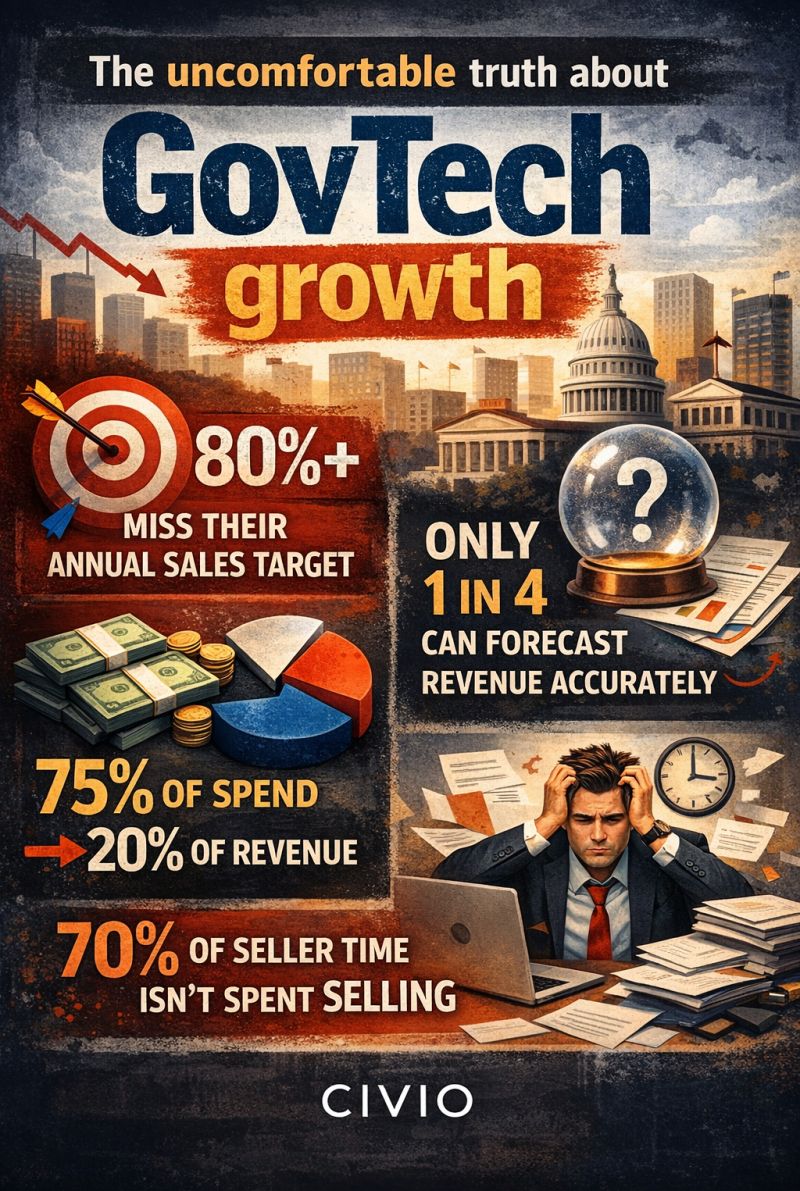
Last year, over 80% of GovTech companies missed top-line sales targets, and only about 27% can forecast within plus or minus 10% accuracy. Roughly 75% of sales and marketing spend produces only 20% of revenue.
Meanwhile, sellers spend 60 to 70% of their time on non-selling work. These results mirror broader enterprise data showing that sales productivity has stagnated and that most AI investments have failed to drive impact because they were layered onto fragmented B2B GTM workflows rather than redesigning them end to end for B2G.
If Q1 felt familiar, these numbers explain why.
The Root Cause Is Fragmentation
Buying signals live in portals and inboxes. Critical context is trapped in PDFs, spreadsheets, and folders. CRM, research, proposal, and forecasting systems operate independently. Teams duplicate work, response times slow, and leaders make decisions with incomplete information. New tools get added while structural complexity keeps increasing.
AI doesn't fix this by adding more alerts, signals, or unverified insights. It fixes it by bringing together third-party data, internal data, and the knowledge that lives in the heads of your people, which is where the most important context actually lives, and orchestrating it into simplified work for teams.
What the Next GTM Advantage Looks Like
The next GTM advantage will come from a single, connected flow from signal to action that reflects how government actually buys. That means unified agency intelligence instead of fragmented research and signals. It means prioritized accounts and routes to market built specifically for the public sector, and bids and RFPs ranked by real fit rather than noisy alerts. It means faster, compliant proposals grounded in proven past performance and clean handoffs across teams from first contact through renewal.
The direction is consistent with how modern CRM and GTM platforms are evolving across markets. The difference in GovTech is that no one has built it yet for the way government actually procures.
You Still Have Three Quarters Left
The 2026 GovTech GTM playbook is not about more headcount or more hustle. It's about rebuilding the revenue engine so systems work together, sellers spend time selling, forecasts reflect reality, and leadership regains control of predictability.
The real payoff is capacity. Real deal shaping happens before procurement starts. It takes time in the account to understand budget timing, internal dynamics, decision-makers, and the actual problem the customer needs solved. Most sellers can't operate on that timeline because fragmented systems consume the time that should go toward it. The companies that fix that will be the ones that pull ahead.