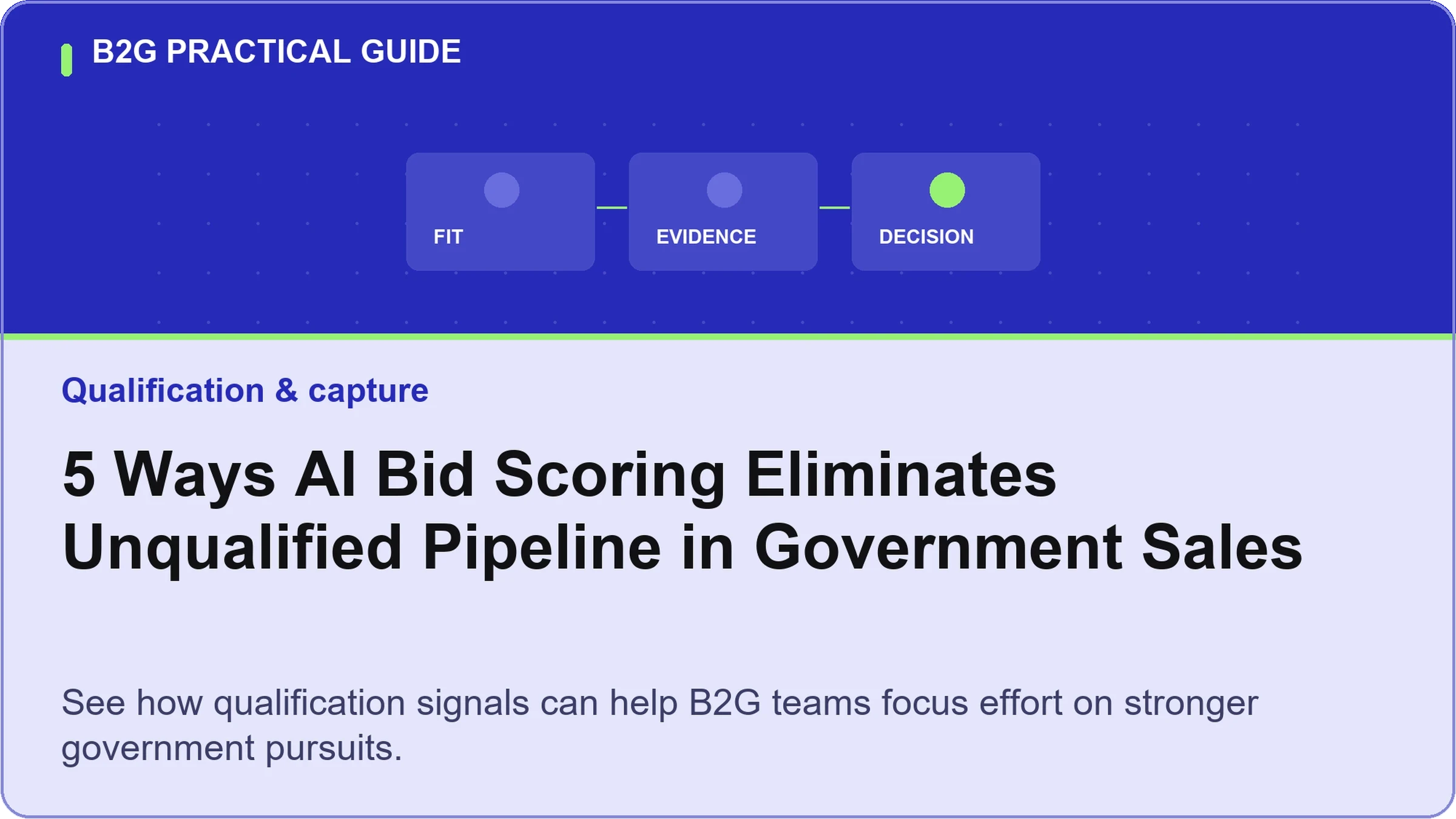
5 Ways AI Bid Scoring Eliminates Unqualified Pipeline in Government Sales
AI bid scoring uses machine learning to evaluate government opportunities. The model weighs your capabilities, past performance, relationships, and competitive position. The output is a numeric score that tells your capture team which pursuits deserve B&P investment.
This matters because most government contractors bid on too much. Seven out of 10 federal contractors report bid success rates of 30% or less. Industry-wide win rates hover around 10-20%.
The problem isn't proposal quality; it's pipeline quality. Teams chase opportunities they were never positioned to win. That drains capture resources from the deals they could actually close.
At Civio, we've built our bid qualification platform around this exact problem. Our FIA scoring framework filters opportunities across Fit, Intent, and Access automatically. Your team works on deals that actually convert.
The five mechanisms below are how AI bid scoring eliminates unqualified pipeline in practice.
Key Terms
AI Bid Scoring: The use of machine learning to evaluate and rank government opportunities. It scores against a contractor's capabilities, historical performance, and competitive position. It replaces manual Pwin worksheets with dynamic, data-driven scoring.
Pwin (Probability of Win): A quantitative assessment of your likelihood of winning a specific opportunity, expressed as a percentage. AI bid scoring produces Pwin scores at scale across your entire pipeline.
Pgo (Probability of Go): Your confidence that you'll actually submit a bid if you continue pursuing the opportunity. Unanet's Probability of Award framework multiplies Pgo by Pwin to produce a weighted pipeline value.
FIA Framework: Civio's scoring model. It evaluates opportunities across three dimensions: Fit, Intent, and Access. Each dimension surfaces a different type of unqualified pursuit.
B&P (Bid and Proposal) Cost: The internal cost a contractor incurs to develop and submit a proposal. Federal proposals routinely cost $30,000 to $65,000+ to produce. Unqualified pipeline directly drives up cost-per-win.
Capture Resources: The combined investment of BD, capture management, technical SMEs, and proposal team time spent positioning for a specific opportunity. Capture resources are finite. AI bid scoring prioritizes where to spend them.
Unqualified Pipeline: Opportunities tracked in your CRM that don't meet your minimum criteria for fit, intent, or access. Unqualified pipeline inflates forecasts, distracts capture teams, and lowers win rates.
1. AI Bid Scoring Filters Fit Before Opportunities Enter Your Pipeline
The first mechanism is the most basic. AI evaluates whether you can actually win a contract before any capture resources touch it. Most unqualified pipeline starts here, with teams pursuing opportunities that don't match their capabilities.
Manual fit assessment relies on capture managers eyeballing solicitations and making subjective calls. The result is inconsistency. One manager sees the contract as a fit; another sees it as a stretch.
AI bid scoring removes that subjectivity by applying the same fit criteria to every opportunity.
How AI Evaluates Fit
AI bid scoring parses each solicitation against your structured capability profile. This includes NAICS codes and certifications like SDVOSB, 8(a), HUBZone, and WOSB. It also weighs past performance keywords, geographic presence, and technical depth signals.
Platforms like Civio go further by comparing the requirements against your historical win patterns. If you've won five similar contracts in the past three years, the system flags this as a high-fit pursuit. If you've never won anything like it, the score reflects that reality.
Key Insight
Fit scoring isn't about whether you could theoretically perform the work. It's about whether the government will believe you can. Past performance is the single strongest predictor of award.
Non-price factors like technical solution, key personnel, and past performance drive 55%+ of award decisions. AI fit scoring weighs these factors automatically. That replaces optimistic capture manager assessments.
What This Eliminates
Capability mismatches that should never have entered your pipeline. This includes opportunities where you lack required certifications. It also covers pursuits where the agency's evaluation criteria favor incumbents you can't displace.
In our experience, fit filtering alone removes 25 to 40 percent of low-value pursuits from a typical B2G pipeline.
2. AI Bid Scoring Separates Real Buying Intent from Procurement Noise
The second mechanism addresses a problem most contractors don't realize they have. Most "opportunities" aren't really opportunities. They're sources sought notices with no funded follow-through, RFIs from agencies still defining their problem, or recompetes locked for incumbents.
AI bid scoring detects these signals and weights them against actual buying intent. The result is a pipeline filtered for real procurement motion rather than theoretical interest.
How AI Reads Intent Signals
AI ingests data from SAM.gov, FPDS, agency forecast databases, and budget documents. From that data, it builds an intent profile for each opportunity.
Strong intent signals include funded budget line items, sources sought followed by formal RFIs and draft RFPs, and incumbent contract expirations approaching. Consistent agency spending patterns in the relevant NAICS category also count.
Weak intent signals include sources sought notices with no follow-up activity. RFIs released near fiscal year end without budget allocation are another warning. Recompetes where the incumbent's CPARS ratings are uniformly excellent round out the list.
Pro Tip
Intent scoring is most valuable when it tracks change over time. A sources sought notice released today carries low intent. The same notice followed by a draft RFP three months later carries high intent.
AI systems that snapshot intent at a single point in time miss this critical signal. Civio's continuous monitoring approach picks up the trajectory, not just the current state.
What This Eliminates
Speculative pursuits that consume capture time without producing wins. The most common offender is the sources sought notice that captures imagination but never converts.
Teams pursue it for six months, only to see the agency drop the requirement entirely or hand it to a different vehicle.
For deeper context on how intent fits into broader pipeline qualification, see our complete go/no-go framework.
3. AI Bid Scoring Maps Access Gaps to Contracting Officers and Program Managers
The third mechanism is the one most contractors underweight: relationship access. You can have perfect fit and obvious intent. But if you've never spoken to the contracting officer or program manager, you're starting from a structural disadvantage.
AI bid scoring maps your organization's relationship strength against the decision-makers for each pursuit. The output is an access score. It tells you whether you have a path to the buyer or whether you're cold-calling.
How AI Maps Access
Modern bid scoring platforms aggregate contact data from agency organizational charts, FPDS award history, and your own CRM. They identify the contracting officer, program manager, and end-user stakeholders for each opportunity. They then score your relationship strength based on documented interactions and capture activity.
Civio's access scoring goes one step further. It maps organizational hierarchies and identifies decision influencers, not just decision-makers.
In our work with B2G teams, the technical evaluator three levels down often shapes the outcome more than the contracting officer.
What This Eliminates
Cold pursuits where you have no path to influence the requirement, the evaluation criteria, or the buying decision. These are pursuits where you'd submit a proposal blind. You'd be hoping your written response is good enough to overcome an incumbent's relationship advantage.
The data is clear on this point. The top 10% of contractors see opportunities 6 to 18 months early and pre-position before solicitations drop. Access scoring tells you when you're in that 10% and when you're not.
4. AI Bid Scoring Models Competitive Disadvantages Against Historical Patterns
The fourth mechanism uses your loss history as a predictive model. Every loss contains a pattern: who beat you, why, and on what type of contract. AI bid scoring detects when a new opportunity matches that loss pattern.
This is where AI bid scoring exceeds what any manual Pwin worksheet can deliver. A capture manager remembers the last few losses; the system remembers everything.
How AI Models Competition
The system ingests historical award data from FPDS and your own win/loss records. It identifies which competitors win in which agencies. It also surfaces which contract types favor which vendors and which technical approaches consistently lose.
Say you've lost three times in a row to the same competitor. When a new opportunity matches that pattern, the AI bid score reflects the reality. High-win-rate contractors treat win/loss data as an operational input, not a post-mortem ritual.
AI bid scoring operationalizes that discipline.
Key Data Point
Mid-sized contractors with structured capture processes target win rates of 40 to 60 percent on fully competed bids. Companies with less mature processes often see win rates in the 20 to 30 percent range on the same opportunities.
The difference isn't proposal quality; it's pipeline quality. Disciplined competitive scoring is one of the biggest contributors to that gap.
What This Eliminates
Pursuits where the competitive math doesn't work. This includes opportunities where the incumbent has dominant past performance. It also covers cases where a specific competitor has won three consecutive similar contracts.
Filtering competitive disadvantages doesn't mean you walk away from every hard pursuit. It means you walk away with eyes open. You don't discover the disadvantage in your debrief.
5. AI Bid Scoring Calculates True B&P Cost Per Dollar of Expected Revenue
The fifth mechanism converts qualitative scoring into financial reality. Every pursuit has a B&P cost; not every pursuit has the expected revenue to justify it. AI bid scoring exposes opportunities where the math doesn't pencil out.
This is the metric that turns scoring into capital allocation. A disciplined Pwin process isn't about guessing; it's about capital allocation. The question is where to spend finite B&P resources for the highest expected return.
How AI Models B&P Efficiency
The system multiplies your Pwin score by the contract ceiling value. It then divides by your estimated B&P cost. The output is expected revenue per B&P dollar invested.
Consider two opportunities. Pursuit A is a $5 million ceiling with 30% Pwin and a $40,000 B&P cost. Pursuit B is a $20 million ceiling with 15% Pwin and a $100,000 B&P cost.
Pursuit A returns $37.50 per B&P dollar; Pursuit B returns $30. The bigger contract isn't the better bet.
Pro Tip
B&P efficiency scoring exposes a common error: chasing big contracts because they're big. For $1M+ federal bids, every serious pursuit consumes pricing resources, capture management time, and proposal labor.
It also consumes subcontractor coordination and executive oversight. A poorly chosen $20M bid can strain indirect rates and exhaust proposal teams more than three well-chosen $5M bids combined.
What This Eliminates
Opportunities that look attractive on paper but don't justify the resource investment. This is the most counterintuitive elimination because the contracts often look like the biggest wins.
The math reveals that lower-ceiling, higher-Pwin pursuits produce more revenue per B&P dollar.
Comparing AI Bid Scoring Approaches
Not all AI bid scoring platforms work the same way. Some bolt scoring onto existing proposal tools. Others build it into a unified qualification platform.
The differences matter when you're trying to eliminate unqualified pipeline at scale.
Platform | Scoring Approach | Key Differentiator |
FIA framework across Fit, Intent, Access | Three-dimensional scoring; AI teammates execute on high-score pursuits; unified qualification and execution platform | |
CLEATUS | Pwin scoring via GovCon Copilot | Upload existing Pwin spreadsheet; AI scores RFPs in 1-2 minutes with citations |
GovEagle | AI scoring against past performance | Runs bid/no-bid analysis using RFP requirements scored against past performance library |
GovDash | Opportunity scoring within full lifecycle | Bid/no-bid as part of broader BD pipeline through proposal management |
Procurement Sciences | Pwin assessment plus competitive analysis | FedRAMP Moderate authorization; tenant-isolated AI architecture |
Sweetspot | AI opportunity matching | Matches opportunities against past performance and capabilities across 1,000+ sources |
Key Insight
The biggest difference between platforms isn't the scoring math; it's what happens after the score. Some tools produce a score and stop.
Civio's AI teammates execute on the score automatically. They route high-fit opportunities into capture workflows and trigger qualified proposal drafts. Scoring without execution is just another dashboard.
Common Mistakes When Adopting AI Bid Scoring
Mistake 1: Treating the score as the decision.
AI bid scoring informs go/no-go decisions; it doesn't make them. Teams that auto-pursue every opportunity above a threshold miss strategic context the model can't see. Use scores as inputs to human judgment.
Mistake 2: Skipping the historical data upload.
AI bid scoring needs your past wins and losses to be accurate. Teams that deploy without uploading 24 to 36 months of historical pursuits get generic scores. Invest the upfront time to feed in your real history.
Mistake 3: Scoring opportunities once and forgetting them.
Pursuit conditions change. The incumbent's CPARS rating drops, your relationship with the program manager strengthens, or a teaming partner emerges. AI bid scoring should re-evaluate continuously.
Mistake 4: Ignoring scores you don't like.
Capture managers sometimes override low scores on opportunities they're emotionally invested in. Track these overrides. If your win rate on overridden pursuits trails your win rate on AI-recommended pursuits, the data is telling you something.
Mistake 5: Deploying scoring without changing your process.
AI bid scoring only works if your team actually walks away from low-score opportunities. Without process discipline backing up the technology, scoring becomes another tab in another dashboard.
Metrics to Track After Deploying AI Bid Scoring
Measuring the impact of AI bid scoring requires tracking outcomes, not just adoption.
Metric | What It Measures | Target After 90 Days |
No-bid rate | % of opportunities filtered before capture investment | 40-60% (higher signals stronger qualification) |
Win rate | Proposals won vs. submitted | Stable or improving as low-Pwin bids are filtered out |
B&P cost per win | Total B&P spend divided by contracts won | 20-40% reduction from baseline |
Pipeline coverage ratio | Pipeline value vs. revenue target | 3:1 minimum after low-quality pursuits removed |
Pwin score accuracy | Predicted Pwin vs. actual win/loss outcomes | Within 15% variance after 6-12 months of feedback data |
Capture time per opportunity | Average hours spent on each pursued opportunity | Increasing (more time on fewer, better deals) |
The counterintuitive metric to watch is capture time per opportunity. Successful AI bid scoring deployments often increase capture hours per pursuit. That's because teams concentrate effort on better-qualified deals.
The total pipeline shrinks, but win rate and revenue per opportunity rise.
Start Here: Your First 5 Steps
Audit your current pipeline for unqualified pursuits. Pull every opportunity in your capture stage. Assess each against fit, intent, access, and competitive position. Most teams find 30 to 50 percent shouldn't have been there.
Document your historical win/loss data. Compile 24 to 36 months of pursuits with win/loss outcomes, competitor information, and Pwin scores at decision time. This data trains your AI scoring model.
Define your fit, intent, and access criteria. Before adopting any AI tool, write down what disqualifies an opportunity. If you can't articulate it, your AI model won't either. The go/no-go framework guide walks through this in detail.
Pilot AI scoring on live pipeline. Test the platform against opportunities your team is actively pursuing. Compare AI scores to your capture manager's manual assessments. Investigate discrepancies; they reveal both AI calibration issues and human bias.
Build a scoring-based no-bid process. Set a minimum score threshold below which opportunities are automatically declined. Allow senior leader overrides. Track override outcomes to refine the threshold over time.
How AI Bid Scoring Connects to Broader Revenue Orchestration
Bid scoring works best as part of a connected revenue orchestration system, not a standalone tool. When scoring lives in one platform and capture management lives in another, the score doesn't trigger action. It just sits in a report.
Civio's approach unifies scoring with execution. A high FIA score doesn't just appear in a dashboard. It routes the opportunity into the right capture workflow, surfaces relevant past performance, and triggers proposal drafting when the RFP arrives.
The score becomes operational rather than informational.
For a complete view of how scoring fits into the broader B2G workflow, see our B2G Revenue Orchestration 101 guide.
Frequently Asked Questions
What is AI bid scoring in government sales?
AI bid scoring uses machine learning to evaluate government opportunities. It weighs your capabilities, past performance, relationship access, and competitive position. The output is a numeric Pwin or fit score.
The score helps capture teams decide which pursuits deserve B&P investment and which should be filtered out before they consume resources.
How accurate is AI bid scoring compared to manual Pwin assessment?
AI bid scoring is more consistent than manual assessment because it applies the same scoring criteria to every opportunity. Manual Pwin scoring varies widely depending on who completes the worksheet and when. AI removes that subjectivity.
The accuracy of the model itself depends on training data quality. The more wins and losses you feed in, the better the predictions become.
Can AI bid scoring replace human go/no-go decisions?
No, and it shouldn't. AI bid scoring informs the decision. The final call requires human judgment about strategic fit, relationship dynamics, and factors the model can't see.
The goal is data-driven decisions, not automated decisions. Teams that treat AI scores as recommendations rather than verdicts get the best results.
What data does AI bid scoring need to work?
AI bid scoring needs four data inputs at minimum. These are your capability profile (NAICS codes, certifications, past performance), historical win/loss data, agency-level buying patterns, and the solicitation itself.
The more historical pursuit data you feed in, the better the scoring becomes. Most platforms produce useful scores within 30 to 90 days of deployment.
How much does AI bid scoring reduce unqualified pipeline?
Teams using AI bid scoring typically eliminate 40 to 60 percent of low-fit pursuits before any capture resources are committed. That doesn't mean they bid less. It means they reallocate capture and B&P investment to higher-Pwin opportunities.
The downstream effect is a smaller, higher-quality pipeline that produces more wins per dollar of B&P spend.
What's the difference between AI bid scoring and a traditional Pwin worksheet?
Traditional Pwin worksheets are static Excel templates that score opportunities on a fixed list of factors. A capture manager completes them manually. AI bid scoring is dynamic.
It pulls live data from your CRM, past performance database, agency forecasts, and solicitation content. It then scores against patterns from your historical pursuits. Worksheets capture a moment in time; AI scoring updates continuously.
Which AI bid scoring platform is best for small government contractors?
The best platform depends on your security requirements, contract types, and existing tool stack. Civio is purpose-built for B2G teams that want unified scoring, qualification, and execution in one platform.
Other options like CLEATUS, GovEagle, and GovDash offer bid/no-bid analysis as part of broader workflows. Small contractors should prioritize platforms that produce useful scores quickly and integrate with their existing CRM.