7 Best Government Proposal Automation Platforms
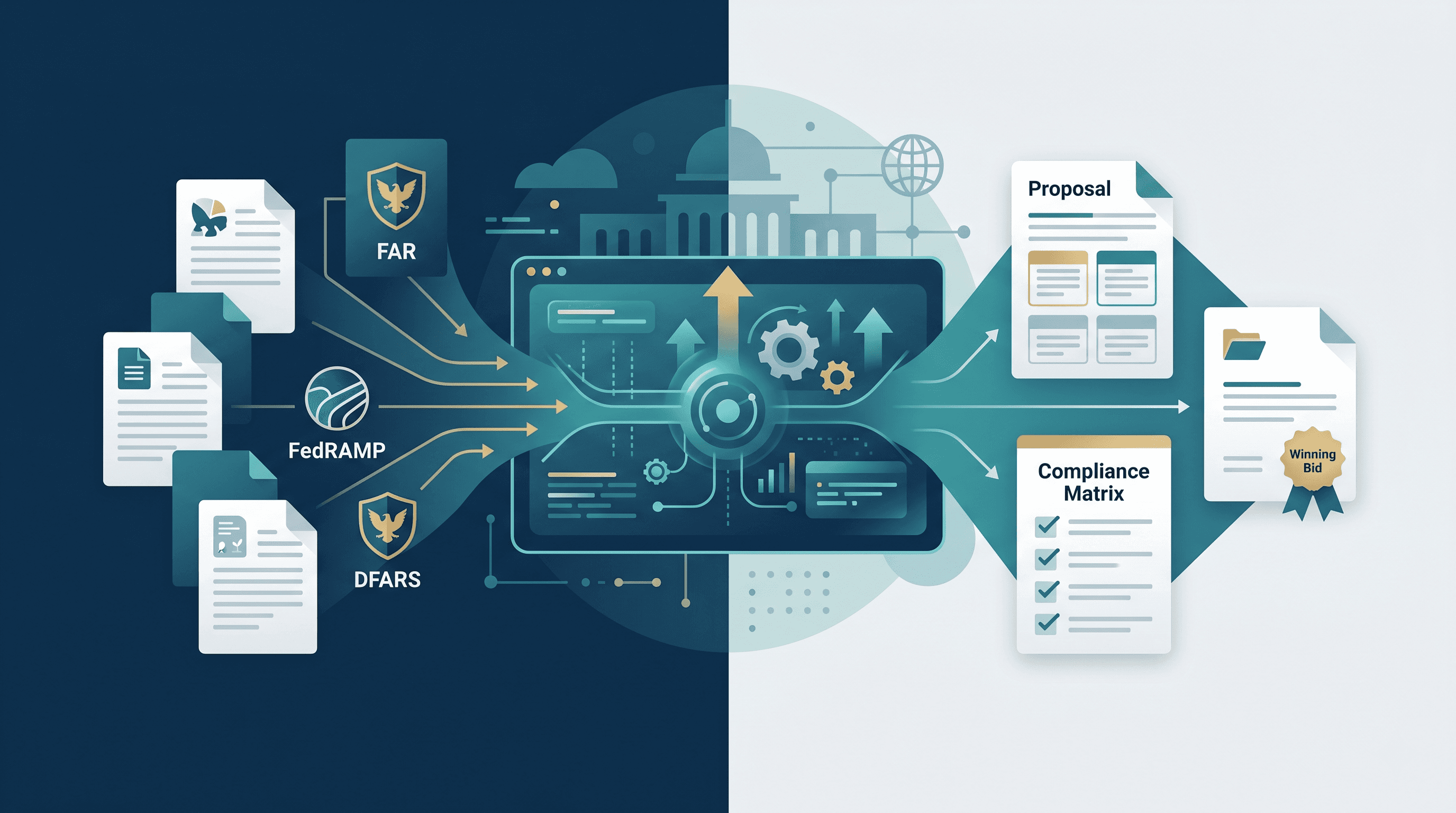
Government proposal automation is the use of software to streamline and accelerate the creation, management, and submission of proposals in response to government solicitations. Modern platforms automate requirement extraction, compliance matrix generation, content drafting, review workflows, and submission formatting to reduce manual effort by 50 to 70%.
The need for proposal automation in government contracting is acute. Federal solicitations routinely exceed 100 pages. They require strict compliance with FAR, DFARS, and agency-specific regulations. Teams selling to government spend 60 to 70% of their time on non-strategic work including qualification, drafting, and admin. Research shows about 20% of RFPs go unfinished each year, costing an average of $725,000 in lost revenue per organization.
The automation landscape has shifted fundamentally in 2026. Loopio's RFP Trends Report found that generative AI adoption among proposal teams doubled in one year, from 34% to 68%. The question is no longer whether to automate proposal work. It's whether the automation understands government procurement well enough to produce compliant, competitive content without extensive rework.
This guide ranks the seven best government proposal automation platforms in 2026. The evaluation considers automation depth, government-specific compliance, AI writing quality, lifecycle coverage, security posture, and integration with existing tools.
Key Terms
Proposal Automation: Using software to execute proposal tasks that were previously manual: requirement extraction, content drafting, compliance checking, form filling, and review routing. Automation does the work; management organizes it.
Compliance Matrix: A structured document mapping each solicitation requirement to the corresponding proposal section. Automated generation ensures complete requirement coverage and prevents disqualification from missed items.
Section L and M: Federal solicitation sections defining proposal instructions (L) and evaluation criteria (M). Platforms that parse beyond L and M into Statements of Work and attachments capture requirements other tools miss.
Content Library: A centralized repository of pre-approved responses, past performance narratives, resumes, and boilerplate. Automation platforms draw from these libraries while generating tailored content for each solicitation.
Color Review: A structured government proposal review process. Pink Team reviews outlines, Red Team checks compliance and quality, Gold Team conducts final executive review. Some platforms automate portions of this workflow.
FAR (Federal Acquisition Regulation): The primary rules governing U.S. federal procurement. FAR-aware automation platforms parse requirements against these regulations, producing content that meets compliance standards automatically.
FedRAMP: Federal Risk and Authorization Management Program. FedRAMP High is the most stringent cloud security standard, required for platforms handling highly sensitive government proposal data including CUI and ITAR content.
Key Insight
Government proposal automation has evolved through three phases. Phase one (2015 to 2020) automated document assembly: templates, content libraries, and version control. Phase two (2020 to 2024) added AI-assisted features: smart search, content suggestions, and basic drafting. Phase three (2024 to present) delivers AI-native automation: autonomous requirement extraction, compliant narrative generation, and end-to-end workflow execution. The platforms on this list are evaluated on phase-three capabilities, where the AI doesn't assist the team. It does the work.
1. Civio
Quick Summary
Civio automates the full government proposal lifecycle as part of a broader B2G revenue workflow. Its AI teammates extract requirements, draft compliant proposals from approved content, fill requirement matrices, and route deals forward without manual handoffs between qualification, drafting, and submission.
Civio redefines what government proposal automation means by extending it beyond the proposal stage. Most automation platforms start when the RFP arrives and end when the draft is complete. Civio's automation starts at the first buying signal and continues through qualification, proposal generation, sales engineering, and post-sale execution.
Incubated by AI Fund, the venture studio led by Dr. Andrew Ng, Civio deploys specialized AI teammates for each revenue stage. The RFP Proposal Teammate reads solicitation files, pulls from approved content libraries, fills complex government forms, and delivers compliant first drafts. A Sales Engineer Teammate fills requirement matrices cell by cell with verified, source-linked answers.
The upstream automation is what separates Civio from proposal-only tools. A RevOps Teammate scores and routes every opportunity on fit, intent, and access before any proposal work begins. A BDR/SDR Teammate ranks deals by budget, timing, and relationship strength. This means proposals are only generated for opportunities the AI has already qualified as worth pursuing.
Civio also automates teaming partner identification. When capability gaps appear during the proposal process, the platform recommends partners based on compliance requirements and relationship history. The 30-day proof-of-value sprint lets teams evaluate ROI before committing.
Key Features
AI teammates automating RevOps, BDR/SDR, proposal, sales engineering, professional services, and customer success
Automated proposal drafting from approved content libraries with built-in compliance tracking
Requirement matrix completion with verified, source-linked answers filled cell by cell
Opportunity scoring on fit, intent, and access, ensuring proposals target only qualified deals
Teaming partner recommendations when capability gaps appear during proposal work
Unified CRM and data source integration into a single automated flow of action
30-day proof-of-value sprint for evaluation
Who Should Choose Civio
B2G revenue teams where proposal automation must connect to upstream qualification and downstream execution, not just the drafting stage
Companies selling SaaS, cloud, or IT services to government that are drowning in the manual work between opportunity discovery and proposal submission
Revenue leaders who want AI that automates the entire sales cycle, not just the document production portion
2. GovDash
Quick Summary
GovDash automates the government proposal lifecycle from opportunity discovery through contract management. Its FAR-trained AI parses complete solicitation packages, generates compliance matrices, and drafts technical narratives 50 to 60% faster than manual methods.
GovDash is the strongest proposal-centered automation platform in the GovCon market. Its four modules, Discover, Capture, Proposal, and Contract, create a continuous automated workflow. The company raised a $30M Series B in January 2026. Its customers won more than $5 billion in government contracts in 2025.
The proposal automation engine parses full solicitation packages, not just Sections L and M. It captures requirements hidden in Statements of Work, amendments, and attachments. SPATHE Systems reported cutting draft turnaround by 90% and scaling IDIQ responses from two to eight per month without adding staff. Native Microsoft Word and Salesforce integration keeps teams in familiar environments.
Key Features
FAR-trained AI parsing full solicitation packages beyond Sections L and M
Automated compliance matrix generation with requirement extraction
Proposal drafting reducing cycle times by 50 to 60%
Dash AI assistant with context-aware workflow execution across modules
Native Microsoft Word and Salesforce integration
FedRAMP-compliant infrastructure on Azure GovCloud
Who Should Choose GovDash
Federal contractors that need automation centered on the proposal lifecycle from capture through contract management
Mid-market firms scaling bid volume without adding proposal headcount
Proposal teams working primarily in Microsoft Word that want AI embedded in their existing tools
GovDash vs. Civio
GovDash automates the capture-to-contract lifecycle with proposal drafting as the core workflow. Civio automates the full go-to-market cycle with AI teammates handling qualification, proposal, engineering, and post-sale. GovDash is the stronger choice for dedicated proposal teams. Civio is the stronger choice for revenue teams that need the entire sales cycle automated from first signal through close.
Comparison Point | Civio | GovDash |
|---|---|---|
Automation Scope | Signal through post-sale | Capture through contract |
AI Architecture | Specialized AI teammates per function | Single AI assistant across modules |
Pre-Proposal Automation | RevOps, BDR/SDR, opportunity scoring | Bid Match + capture management |
Proposal Drafting | AI from approved content libraries | FAR-trained AI from solicitation data |
Post-Proposal | Sales engineering, customer success (beta) | Contract Cloud administration |
Best For | Full-funnel B2G revenue automation | Proposal-centered GovCon automation |
3. Procurement Sciences (Awarded AI)
Quick Summary
Procurement Sciences automates the government contracting lifecycle through Awarded AI with compliance-first drafting, predictive PWIN scoring, color review automation, and structured gate reviews. FedRAMP Moderate authorized, serving 300+ organizations.
Procurement Sciences approaches proposal automation through compliance discipline. The company closed a $30M Series B in November 2025, backed by Catalyst Investors and Battery Ventures. The platform automates opportunity matching, proposal drafting with compliance verification, win strategy generation, and post-award delivery management.
The automation model is process-structured. Every stage is organized into assignable tasks with gate reviews and validation checkpoints. This makes every automated action auditable, a critical requirement for defense and intelligence contractors. Deployment options include Azure Commercial, GovCloud (GCC High), and on-premises for CUI and ITAR data. Teams report 90%+ efficiency gains and up to 10x proposal output.
Key Features
FedRAMP Moderate with CMMC and NIST 800-171 alignment
Compliance-first AI drafting with automated cross-checking against RFP requirements
Predictive PWIN scoring for opportunity prioritization before automation begins
Color review automation with structured gate reviews and validation checkpoints
Competitive intelligence and agency preference analysis informing automated content
Flexible deployment: commercial cloud, GovCloud, or on-premises
Who Should Choose Procurement Sciences
Defense and intelligence contractors requiring FedRAMP authorization and CUI-grade data isolation
Large GovCon firms needing structured, auditable automation processes with formal gate reviews
Organizations where compliance verification is as important as drafting speed in the automation workflow
Procurement Sciences vs. Civio
Procurement Sciences automates through structured, auditable workflows with compliance gates at every stage. Civio automates through autonomous AI teammates that execute without waiting for manual checkpoints. Procurement Sciences is the stronger choice for regulated environments where every automated action must be documented. Civio is the stronger choice for teams that need speed and full-funnel coverage from qualification through close.
Comparison Point | Civio | Procurement Sciences |
|---|---|---|
Automation Model | Autonomous AI teammates | Structured process with gate reviews |
Security | Enterprise-grade | FedRAMP Moderate, CMMC, NIST 800-171 |
Deployment | Cloud-based | Commercial, GovCloud, on-premises |
Review Automation | Integrated quality checks | Full color review automation with gates |
Post-Award | Customer success (beta) | Full contract delivery management |
Best For | Speed-focused B2G revenue teams | Compliance-focused defense contractors |
Pro Tip
When evaluating government proposal automation platforms, test three things: how accurately the tool extracts requirements from a real solicitation, how usable the automated first draft is without rewriting, and whether the compliance matrix catches requirements hidden outside Sections L and M. In our testing, the gap between platforms is largest on requirement extraction from Statements of Work and attachments, not on the visible sections that every tool handles adequately.
4. AutogenAI Federal
Quick Summary
AutogenAI Federal automates proposal writing with the highest AI writing quality in the market, operating in a FedRAMP High authorized environment. It builds a custom AI language model per customer and covers the full proposal lifecycle from capture through compliance review.
AutogenAI Federal automates the writing stage of government proposals at a quality level that other tools haven't matched. The platform builds a dedicated AI engine trained exclusively on each customer's documents, past proposals, and win themes. Three engines power the output: Creative AI generates original narrative, Library AI draws from past proposals, and Internet AI pulls real-time cited data.
The FedRAMP High authorization, accredited by the U.S. Air Force with CMMC 2.0 and DoD IL5 compliance, makes AutogenAI Federal the most security-cleared proposal automation tool available. Users report 70% drafting time reduction and 85% overall efficiency gains. Independent MH&A research found that AutogenAI customers grew revenue 12.4% year-on-year versus a 7.1% decline among non-users.
Key Features
Custom AI language engine trained on each customer's documents and writing voice
FedRAMP High authorized with CMMC 2.0 and DoD IL5 compliance
Three AI engines: Creative AI, Library AI, and Internet AI with real-time citations
Full lifecycle automation from capture planning through compliance review and submission
Multi-document shredding and automated compliance matrix generation
AI-powered color review scoring automated proposals against RFP requirements
Who Should Choose AutogenAI Federal
Proposal teams where automated writing quality, not just speed, is the primary competitive differentiator
Defense and intelligence contractors requiring FedRAMP High and IL5 environments for proposal data
Organizations that need automation to produce persuasive, differentiated narrative, not just compliant boilerplate
AutogenAI Federal vs. Civio
AutogenAI Federal automates proposal writing at the highest quality level within FedRAMP High security. Civio automates the full revenue cycle with AI teammates from qualification through close. AutogenAI is the best choice for teams that already manage their pipeline well and need an automation partner for the writing stage. Civio is the best choice when the automation need spans the entire signal-to-submission workflow.
Comparison Point | Civio | AutogenAI Federal |
|---|---|---|
Automation Strength | Full-funnel autonomous execution | Best-in-class writing automation |
Security | Enterprise-grade | FedRAMP High, CMMC 2.0, DoD IL5 |
Pre-Proposal Automation | RevOps, qualification, pipeline scoring | Capture planning, bid/no-bid analysis |
Content Approach | Approved content library + AI drafting | Custom AI model per customer |
Lifecycle Scope | Signal through post-sale | Capture through submission |
Best For | Full-funnel B2G revenue automation | Writing-quality-focused proposal automation |
5. GovSignals
Quick Summary
GovSignals automates capture, intelligence, proposal, and contracting workflows in one platform with FedRAMP High authorization. It combines automated proposal generation with insider-sourced intelligence not available on public procurement portals.
GovSignals automates the full proposal workflow from solicitation upload to ready-to-edit draft. The platform generates automated go/no-go assessments, compliance checks, proposal outlines, and full draft proposals. Its insider-sourced intelligence surfaces opportunities before they appear on SAM.gov, giving teams a head start on positioning and capture.
Over 400 organizations use GovSignals across federal, SLED, and international procurement. The platform supports SF1449, Sections L and M, DoD intelligence formats, and other complex solicitation structures. It creates, edits, and exports proposals in Word, Excel, PowerPoint, and PDF. Most clients report results within two weeks of white-glove onboarding.
Key Features
FedRAMP High authorization for the most sensitive federal proposal data
Automated go/no-go assessment, compliance checks, outlines, and draft generation
Insider-sourced opportunity intelligence beyond public procurement feeds
Full document automation in Word, Excel, PowerPoint, and PDF formats
AI that analyzes internal files, reads policies, and preps teams for meetings
White-glove onboarding with results in approximately two weeks
Who Should Choose GovSignals
Contractors handling classified or highly sensitive data requiring FedRAMP High for proposal automation
Teams that want insider-sourced intelligence feeding their automated proposal workflows
Defense primes needing end-to-end secure automation from capture through contract execution
GovSignals vs. Civio
GovSignals automates proposals within FedRAMP High security with analyst-sourced intelligence informing every output. Civio automates the full revenue cycle with AI teammates executing across every stage. GovSignals is the strongest choice for high-security environments. Civio is the strongest choice for teams that need automation connecting qualification, proposal, and post-sale into a single continuous workflow.
Comparison Point | Civio | GovSignals |
|---|---|---|
Security Level | Enterprise-grade | FedRAMP High |
Intelligence | AI-scored unified signals | Insider-sourced + public feeds |
Automation Scope | Full funnel: signal through post-sale | Capture through contract execution |
Document Formats | Proposals and requirement matrices | Word, Excel, PowerPoint, and PDF |
Onboarding | 30-day proof-of-value sprint | White-glove, ~2 week results |
Best For | Full-funnel B2G revenue automation | High-security defense proposal automation |
Key Data Point
SPATHE Systems, a GovDash customer, cut proposal draft turnaround by 90% and scaled IDIQ no-notice responses from two per month to seven or eight without adding staff. Procurement Sciences reports teams achieving up to 10x proposal output with 90%+ efficiency gains. AutogenAI's independent MH&A research shows a 19.5 percentage point revenue performance gap between automation users and non-users. The data consistently shows that government proposal automation isn't a productivity luxury. It's a revenue multiplier.
6. Responsive (formerly RFPIO)
Quick Summary
Responsive automates RFP responses using AI agents that shred documents, generate first-pass answers from approved content, route work to SMEs, and validate completeness through the TRACE Score system. Used by over 2,000 organizations including Microsoft.
Responsive is one of the most established proposal automation platforms in the market. Its AI agent architecture automates four key workflows: document shredding (extracting questions from imported RFPs), first-pass answer generation from the centralized content library, SME routing for specialized questions, and quality validation. Microsoft's proposal team reported an estimated $746 ROI for every $1 invested.
The platform supports 20+ native integrations, guided project workflows, content translation, and multi-language support. Its strength is enterprise scale and workflow coordination. The limitation for government contractors is the absence of government-specific automation: no FAR compliance checking, no Section L/M parsing, and no FedRAMP-grade security. Responsive automates the mechanics of proposal response well, but the compliance layer remains manual for government work.
Key Features
AI agents automating document shredding, drafting, SME routing, and validation
TRACE Score system validating automated AI output for accuracy and compliance
Centralized content library with automated governance and maintenance
20+ native integrations including Salesforce, Slack, and Microsoft 365
Guided project workflows with real-time collaboration and commenting
Content translation and multi-language automation support
Who Should Choose Responsive
Large enterprise teams automating high volumes of both commercial and government RFPs, RFIs, and questionnaires
Organizations with complex tech stacks that need deep integration support for their automation workflows
Proposal operations teams where workflow coordination and content governance are the primary automation goals
Responsive vs. Civio
Responsive automates proposal response within a general-purpose enterprise platform. Civio automates within a B2G-specific revenue workflow. Responsive offers broader commercial coverage and deeper enterprise integrations. Civio offers deeper government specificity with FAR-aware automation and full-funnel coverage. Teams responding primarily to government solicitations will find Civio's automation more immediately productive because the compliance layer is built in, not bolted on.
Comparison Point | Civio | Responsive |
|---|---|---|
Market Focus | Government (B2G) sales | Cross-industry enterprise |
Gov Compliance Automation | FAR-aware AI, government forms | No FAR-specific automation |
AI Architecture | Specialized AI teammates | AI agents for drafting and routing |
Integrations | Unified CRM + data sources | 20+ enterprise integrations |
Pre-Proposal Automation | Pipeline scoring, qualification | None (response stage only) |
Best For | B2G revenue teams | Enterprise proposal operations |
7. Loopio
Quick Summary
Loopio automates proposal responses through content retrieval and reuse, powered by Response Intelligence AI trained on a decade of data and 500,000+ projects. Its portal automation browser extension auto-fills answers directly into government e-procurement portals.
Loopio's automation model is retrieval-first. The AI searches approved content libraries to find the best existing answers for each question, then generates first drafts by combining and adapting retrieved content. This approach ensures governance and accuracy because every automated output traces back to pre-approved material. The platform's AI also automates library maintenance by flagging duplicate and stale content.
The portal automation feature is a genuine differentiator for government teams. A browser extension automatically identifies questions and populates verified answers directly into web-based procurement portals. For teams responding to high volumes of questionnaire-style government RFPs on e-procurement sites, this automation creates significant time savings. The limitation is depth: Loopio automates content reuse effectively but doesn't generate original narrative for novel questions or complex government proposals.
Key Features
Response Intelligence AI trained on 10+ years of data and 500,000+ projects
Portal automation browser extension auto-filling government e-procurement portals
Automated content library maintenance with duplicate and stale content detection
Smart SME recommendation automating routing based on historical contributions
Granular governance controls with role-based AI permissions and version tracking
Integrations with Salesforce, Microsoft 365, SharePoint, and Google Drive
Who Should Choose Loopio
Enterprise teams automating high volumes of standardized, questionnaire-style government RFPs
Organizations with well-maintained content libraries that need automated governance and freshness controls
Teams responding heavily on web-based procurement portals where auto-fill automation creates value
Loopio vs. Civio
Loopio automates through content retrieval and reuse from approved libraries. Civio automates through AI teammates that generate tailored proposals within a full-funnel revenue workflow. Loopio is stronger for high-volume, questionnaire-style responses where approved content already exists. Civio is stronger for narrative-heavy government proposals that require original content connected to deal context and upstream qualification.
Comparison Point | Civio | Loopio |
|---|---|---|
Automation Model | AI generation from content libraries | Content retrieval and reuse |
Novel Content | AI generates tailored narrative | Limited when library lacks answers |
Gov Compliance Automation | FAR-aware, compliance tracking | No government-specific compliance |
Portal Automation | Integrated into proposal workflow | Industry-first browser extension |
Pre-Proposal Automation | Pipeline scoring, qualification | None |
Best For | Full-funnel B2G revenue automation | High-volume questionnaire automation |
Before and After: Government Proposal Automation
Before automation: A 4-person proposal team manually reviews a 120-page solicitation over 3 days, spends 2 weeks drafting responses across scattered documents, and dedicates 1 week to compliance review and formatting. Total: 100+ hours per proposal, 3 submissions per quarter.
After automation: AI extracts requirements in minutes, generates a compliant first draft in hours, builds the compliance matrix automatically, and flags gaps before human review begins. The team focuses on strategy, differentiation, and refinement. Total: 30 to 40 hours per proposal, 8 to 10 submissions per quarter with higher compliance rates and better win outcomes.
Full Comparison: All 7 Government Proposal Automation Platforms
Capability | Civio | GovDash | Procurement Sci. | AutogenAI Fed. | GovSignals | Responsive | Loopio |
|---|---|---|---|---|---|---|---|
Gov-Specific | Yes (B2G) | Yes (GovCon) | Yes (GovCon) | Yes (Federal) | Yes (GovCon) | No | No |
Automation Scope | Signal to post-sale | Capture to contract | Discovery to delivery | Capture to submission | Capture to contract | Response stage | Response stage |
AI Autonomy | AI teammates execute | AI assistant assists | Structured task AI | Custom AI per customer | Auto go/no-go + drafts | AI agents route + draft | Content retrieval |
Compliance Matrix | Yes | Yes | Yes | Yes | Yes | Partial | No |
Writing Quality | Compliant + contextual | FAR-compliant | Compliance-first | Best-in-class | Compliance-focused | First-pass draft | Library-dependent |
Security | Enterprise | FedRAMP-eq. | FedRAMP Moderate | FedRAMP High | FedRAMP High | SOC 2 | SOC 2 |
Pre-Proposal | Full pipeline | Capture mgmt | Capture mgmt | Capture + bid/no | Capture + intel | None | None |
Best For | B2G revenue teams | Proposal teams | Defense/intel | Writing quality | High-security | Enterprise ops | High-volume Q&A |
Start Here: Action Checklist
Map the manual work. Track every manual step from RFP arrival to proposal submission. Count hours spent on requirement extraction, content search, drafting, compliance checking, formatting, and review coordination. The automation platform that eliminates the most manual hours delivers the most ROI.
Classify the proposal type. If the team responds primarily to narrative-heavy government solicitations with FAR compliance, prioritize government-specific automation (Civio, GovDash, Procurement Sciences, AutogenAI Federal). If the team handles both commercial questionnaires and government RFPs, cross-industry platforms (Responsive, Loopio) may cover more ground.
Define the security floor. Proposals involving CUI, ITAR, or classified data require FedRAMP-authorized platforms: AutogenAI Federal and GovSignals (High), or Procurement Sciences (Moderate). With CMMC 2.0 enforcement, this isn't optional for defense contractors.
Test with a real solicitation. Upload a recently completed RFP into 2 to 3 finalist platforms. Measure requirement extraction accuracy, first-draft usability, compliance matrix completeness, and remaining manual effort. This single test reveals more than any demo or feature list.
Evaluate the automation boundary. Ask each vendor: where does the automation end and manual work begin? The best platforms automate from requirement extraction through compliance-verified draft. The weakest stop at content suggestion, leaving drafting, formatting, and compliance to humans.
Frequently Asked Questions
What is government proposal automation?
Government proposal automation is the use of software to streamline and accelerate proposal creation, management, and submission in response to government solicitations. Modern platforms automate requirement extraction, compliance matrix generation, content drafting, review workflows, and formatting. The goal is reducing manual effort by 50 to 70% while improving compliance and win rates.
How does proposal automation differ from proposal management?
Proposal management organizes the human-driven process: tasks, deadlines, and reviews. Proposal automation executes the work: extracting requirements, generating drafts, building compliance matrices, and filling forms. Management tells teams what to do; automation does it. The best 2026 platforms combine both.
Can automated proposals pass government compliance reviews?
Leading platforms generate proposals meeting FAR compliance requirements. GovDash reports 50 to 60% faster cycles. Procurement Sciences reports 90%+ efficiency gains. Human review remains essential before final submission. AI produces compliant first drafts that experts refine, not finished products bypassing review.
What security standards do government proposal automation tools need?
For federal proposals with CUI or ITAR data, FedRAMP authorization is the standard. AutogenAI Federal and GovSignals hold FedRAMP High. Procurement Sciences holds Moderate. SOC 2 Type II is the minimum for less sensitive work. CMMC 2.0 enforcement makes non-authorized tools a compliance risk.
How long does implementation take?
Implementation ranges from days to months. GovDash reports week-one productive use. GovSignals delivers results within two weeks. Civio offers a 30-day proof-of-value sprint. Enterprise platforms like Responsive typically require multi-week onboarding with dedicated training.
Should contractors use general or government-specific automation?
Teams responding primarily to government solicitations benefit significantly from government-specific platforms. These tools understand FAR, Section L/M parsing, compliance matrix structures, and government forms. General platforms like Responsive and Loopio work for commercial questionnaires but lack the compliance automation government proposals require.
Pro Tip
The true measure of proposal automation isn't draft speed. It's "usable draft rate," the percentage of AI-generated content that survives into the final submission without rewriting. A platform producing a draft in 5 minutes that requires 8 hours of rework isn't faster than one taking 30 minutes with only light editing. When comparing tools, ask vendors for their customers' usable draft rate and request references who can confirm it. That single metric predicts ROI better than any feature list.