How Should Government Contractors Evaluate AI Revenue Orchestration Platforms?
Evaluate the system around the model, not the model. Ask how the platform tests itself when models and data change, how its harness carries work across a multi-year pursuit, and how it grounds every answer in source text you can check.
That is the short version of a talk Civio CTO and co-founder Anindo Banerjea gave on building enterprise AI systems. The full talk is below. This post pulls out what it means for a government contractor buying AI for the revenue cycle.
Why does the model matter less than the system around it?
Models are a commodity now. New ones ship every week. Old ones get retired on the provider's schedule, not yours.
Anindo's point is that the model is a replaceable part. The enterprise system is the evals, the harness, the context and the governance. That is where the work is.
This changes the buying question. A vendor that leads with which model it uses is telling you about the part that will be swapped out next. Ask about the parts that stay.
It also changes cost. The right model for a step is often not the newest or the largest. Civio uses frontier models at build and eval time, to design the harness and decide what context each step needs. At runtime, many individual steps run on small, cheap models. Choosing left or right at one step does not take much reasoning. Choosing what context that step sees does.
Lesson 1: How does the platform keep working when models and data change?
Two things change under every AI system: the models and the input data.
Government solicitations are a good example of the second. Anindo described RFP packages with Excel files holding junk data thousands of columns to the right. A naive system assumes it might matter, pulls all of it into the model's context, and blows the context up. The fix is to strip junk before it reaches the model. The harder part is the next surprise, and there is one almost every week.
Nobody keeps up with that by hand. The answer is an automated regression loop:
A model change or an unusual input triggers the loop.
The system runs the regression tests.
AI checks the results and diagnoses failures.
AI proposes prompt edits and reruns the tests.
If the tests pass, no human needs to look. If they fail, a person steps in.
Every new failure becomes a new test. Anindo said the loop runs without a human about 80% of the time at Civio.
Then there is grounding. Make the AI point to the exact paragraph in the source document that supports its answer. If it cannot, throw the answer out and try again. An answer with no source is a hallucination waiting to be submitted. The session's moderator said he reached the same approach on his own: evaluate against source facts, not string matches.
Ask the vendor: How do you test a model change before it reaches my workflow? What happens when a solicitation arrives in a format you have not seen? Can every answer point to its source text?
Lesson 2: What does the harness do that the model cannot?
The harness manages context, workflow state, permissions and governance. Who is allowed to do what. Whether the agent may take this step. Which rules control the process, and what happens if a step goes wrong. The model needs all of that before it decides. The harness supplies it.
In government sales the harness carries more than one task. A pursuit can start two years before an RFP. Marketing defines the target buyers. The system watches signals: budget meetings, changes to the rules that govern the purchase, and contract expiration dates that tell you when a buyer will be back in the market. Those signals tell you what to talk to the buyer about long before contracting starts. Over time you shape how they see their requirements, so when the RFP lands, your requirements are already in it. Then come response, review, approval and submission.
That work spans departments and years. The harness keeps it on track and nudges people at the right moment: you need to make this call this week.
This is also where horizontal sales tools fall short. They apply a commercial playbook that starts at the lead or the deal. Selling to government starts upstream, with budgets, mandates and contract cycles, often before there is a solicitation.
Ask the vendor: Does the platform track a pursuit from market definition through submission, or does it start at the published solicitation? Where are permissions and approvals enforced: in the workflow, or in a policy document?
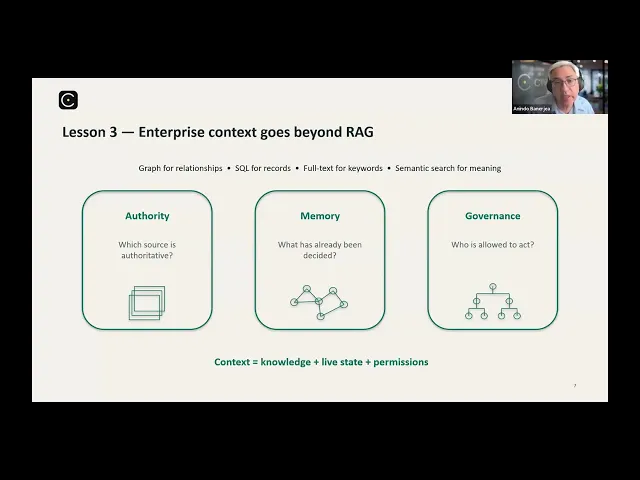
Lesson 3: Why isn't RAG enough for enterprise context?
Enterprise context is not just text in a vector store. Authority, memory, governance, what has already been decided, who may take this step: these are structured. Some belong in SQL. Some are hierarchies and concepts that belong in a graph. Some documents are best found by keyword search, not semantic search. The agent needs all of these tools.
Civio's approved Q&A library shows how they fit:
SQL: approved answers live here so people can review and approve them.
Vector index: the same answers live here too, because the government will not phrase the question the same way twice. Keyword search would miss it.
Graph: account relationships, like who owns the account and which sellers work it, and the concepts that connect questions.
Keyword search: the fallback when semantic lookup comes up empty.
Order matters, and so does cost. Semantic search runs first because it is fast and cheap. Anindo said it finds the right answer about 90% of the time. An eval inside the workflow checks whether the results are close enough to the question. Only when that check fails does the slower graph expansion run, pulling in related concepts and searching again. A reranker narrows roughly 200 candidates to 50, and the reranker gets its own eval so it does not throw out good answers.
Context also decides when the system acts and when it escalates. It keeps provenance: these are the facts I used. If confidence is too low for a high-consequence step, it routes the decision to the right person for approval.
Ask the vendor: Where do approved answers live, and who approves them? What does the system do when the first search comes back weak? Can it show the facts behind a decision and who it escalated to?
A checklist for evaluating AI revenue orchestration platforms
What to evaluate | Ask the vendor | A strong answer |
|---|---|---|
Evals | How do you test a model change before it reaches my workflows? | An automated regression suite. Every failure becomes a test. People review only what fails. |
Grounding | Can every answer cite its source? | Answers without a source paragraph are rejected and retried. |
Messy inputs | What happens with an RFP package in a format you have not seen? | Inputs are cleaned before they reach the model, and new formats become tests. |
Model choice | Which models do you use? | The right model for each step, swapped as models change, with evals proving each swap. |
Harness | Does it run the whole pursuit or one task? | Market definition and signals through submission, across teams. |
Permissions | Where are approvals enforced? | In the workflow, step by step, with named escalation owners. |
Context | How do you store approved content and relationships? | Structured records, a vector index, a graph and keyword search, used in a set order. |
Provenance | Can I see why it made a decision? | Each decision lists the facts used, the confidence and who approved it. |
Security authorization, such as FedRAMP or CMMC scope, is its own review. Run it in parallel. It tells you whether your data is protected. It does not tell you whether the system will still work after the next model release.
What this means for your operating model
Models will keep getting better, faster and cheaper. OpenAI, Anthropic and Google are spending to make sure of it.
Your job is not to pick the winning model. It is to own the evals, the harness and the context, so you can absorb each improvement without breaking the workflow your team depends on. Buy a platform built that way, or plan to build those three things yourself.
Civio is built this way: a governed multi-model harness for businesses that sell to government, covering the revenue cycle from early signals through submission.
Frequently asked questions
How should large government contractors evaluate AI revenue orchestration platforms?
Judge the system around the model. Look for automated evals that catch model and data changes, a harness that tracks the full pursuit with permissions and approvals, answers grounded in cited source text, and a context layer that combines structured records, vector search, a graph and keyword search. Large contractors should weight governance and provenance heavily, because the work spans departments and years.
What is an AI harness?
The harness is the layer around the model. It manages context, workflow state, permissions and governance. It decides what the model sees at each step and what the agent is allowed to do.
Why do evals matter more than prompts?
Prompts break when models or inputs change. Evals catch the break. An automated eval loop finds failures, proposes prompt fixes, reruns the tests and only pulls in a person when the fix does not work.
Should we choose the most advanced AI model?
Choose the right model for each step. Frontier models earn their cost when designing and evaluating the workflow. Many runtime steps can run on smaller, cheaper models once the harness gives them the right context.
Is RAG enough for government proposal content?
No. RAG handles phrasing that changes from one solicitation to the next. Approval status, account hierarchies and related concepts need SQL and a graph, and keyword search covers what semantic search misses.
How do you stop AI from hallucinating in a proposal?
Require grounding. The system must point to the exact paragraph in a source document that supports each answer. If it cannot, the answer is discarded and regenerated.
How is AI revenue orchestration for government different from commercial tools like Outreach or Clari?
Commercial tools start at the lead or the deal. Government buying starts with budgets, mandates and contract cycles, often years before a solicitation. A platform built for government sales tracks those signals and carries the pursuit through response and submission.