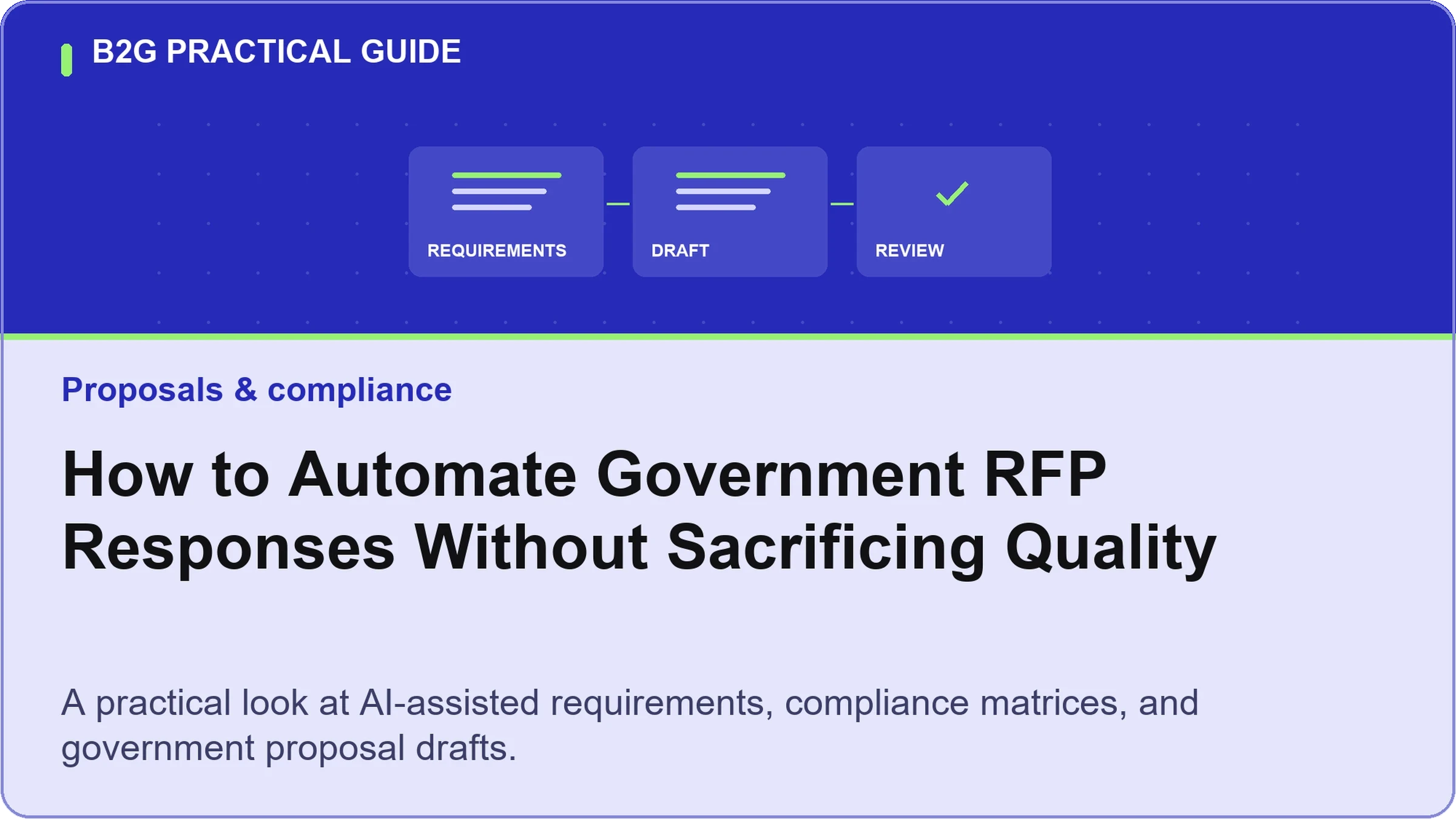
How to Automate Government RFP Responses Without Sacrificing Quality
Government RFP response software uses AI to automate the most time-consuming parts of proposal development: requirement extraction, compliance matrix generation, content drafting, and formatting. The goal isn't to remove humans from the process. It's to shift their time from repetitive assembly work to the strategic thinking that wins contracts.
This matters because proposal teams are stretched thin. According to Loopio's 2026 RFP Response Trends Report, teams now spend an average of 33 hours per RFP response, and bandwidth has become the number-one challenge for proposal teams for the first time. In government contracting, where a single proposal section can take seven or more hours to draft, that time pressure directly affects quality.
RFP automation doesn't mean handing your proposal to a machine. It means using AI to build the foundation so your team can focus on differentiation, win themes, and compliance strategy. At Civio, we've built AI teammates that handle the heavy lifting of RFP responses, from requirement extraction through first-draft generation, so your team reviews the work instead of doing it from scratch.
Key Terms
RFP Automation: The use of AI-powered software to extract requirements from government solicitations, generate draft responses, build compliance matrices, and assemble proposal documents. Modern automation reduces first-draft creation from weeks to hours.
Compliance Matrix: A tracking document that maps every requirement in a government RFP to a specific section of the contractor's response. Missing a single requirement can result in disqualification.
Section L/Section M: The two most critical sections of a federal RFP. Section L contains the proposal preparation instructions. Section M defines the evaluation criteria the government will use to score submissions.
Content Library: A centralized repository of reusable proposal content, including past performance narratives, capability descriptions, team bios, and boilerplate compliance language. AI tools pull from this library to generate tailored first drafts.
Color Team Review: A structured review process used in government proposal development. Common stages include Pink Team (draft review), Red Team (near-final review), and Gold Team (executive review). Each gate assesses compliance, responsiveness, and competitiveness.
B&P (Bid and Proposal) Costs: The internal costs a contractor incurs when preparing a proposal. These include labor hours, subject matter expert time, production costs, and overhead. A single government proposal can cost $65,000 or more to produce.
Win Theme: A concise, compelling message that runs through a proposal explaining why the contractor is the best choice for the specific requirement. Win themes connect the contractor's strengths to the agency's stated priorities.
Shredding: The process of breaking down an RFP into individual requirements, instructions, and evaluation criteria. AI tools automate shredding, which is traditionally one of the most labor-intensive steps in proposal development.
Manual vs. AI-Assisted Proposals: What Actually Changes
The manual government proposal process follows a pattern most capture teams know too well. Someone downloads the RFP, prints it, and starts highlighting requirements by hand. A proposal manager builds a compliance matrix in Excel. Writers hunt through SharePoint for past responses that might be reusable. Formatting happens last and usually under extreme time pressure.
This process works. It's also brutally slow and prone to human error at every stage.
AI-assisted proposals don't replace this process. They compress the early stages so your team has more time for the work that actually differentiates your submission.
Proposal Stage | Manual Process | AI-Assisted Process |
|---|---|---|
RFP shredding | 4-8 hours of manual reading and highlighting | Minutes: AI extracts and categorizes all requirements |
Compliance matrix | 6-12 hours in Excel, high error rate | Auto-generated from extracted requirements, mapped to your response outline |
Content retrieval | Hours searching SharePoint, email threads, old proposals | AI searches your content library and surfaces relevant past responses |
First draft | 7+ hours per section, starting from scratch or old templates | AI generates section drafts from your content library in minutes |
Compliance verification | Manual cross-referencing before submission | Automated gap analysis flags missing requirements in real time |
Win theme integration | Human-driven (unchanged) | Human-driven (unchanged, but now with more time to do it well) |
Key Insight
The last row in that table is the whole point. AI doesn't touch win theme development, pricing strategy, or relationship context. Those are the elements that separate winning proposals from compliant ones. Automation's job is to give your team more hours for that high-value work.
In our experience, the shift isn't dramatic on day one. Teams see the biggest gains after 60 to 90 days, once their content library is indexed and the AI has learned their preferred structure and voice.
How AI Handles Compliance-Heavy Government RFPs
Compliance is where government proposals succeed or fail. A single missed requirement in Section L can disqualify an otherwise strong submission. This is also where AI delivers its most reliable value.
Automated Requirement Extraction
Government RFPs routinely run 100 to 200+ pages. They embed requirements across multiple sections, appendices, and referenced regulations. Manual extraction is slow and error-prone because requirements often appear in unexpected places.
AI proposal tools parse the entire RFP document and extract every requirement, instruction, and evaluation criterion automatically. AI ensures nothing falls through the cracks by generating detailed compliance checklists directly from the RFP. The output is a structured requirements list that feeds directly into your compliance matrix.
Compliance Matrix Generation
Once requirements are extracted, AI maps each one to the corresponding section of your response outline. The result is a draft compliance matrix that shows where every requirement will be addressed and flags any gaps.
This isn't a theoretical improvement. Procurement Sciences reports that teams using their platform see a 75% productivity increase on compliance matrices, reducing a full day's work to roughly two hours.
Pro Tip
Don't wait until draft review to check compliance. The best AI tools provide real-time compliance scoring as your team writes, flagging drift from RFP requirements before it becomes a structural problem. This turns compliance from a gate at the end of the process into a guardrail throughout.
FAR/DFARS Cross-Referencing
Government RFPs reference specific FAR and DFARS clauses that impose requirements on your proposal and your contract performance. Missing a clause reference can create legal and compliance exposure.
GovCon-specific AI tools are trained on federal acquisition regulations. They identify when an RFP invokes a specific clause, surface the relevant requirements, and flag whether your response addresses them. Generic AI tools like ChatGPT don't have this capability.
The Human Layer
AI catches the structural compliance issues: missing sections, unaddressed requirements, incomplete clause references. It doesn't catch strategic compliance failures, like a response that technically addresses a requirement but does so in a way that scores poorly against evaluation criteria.
That's your team's job. AI handles the checklist; humans handle the judgment.
Speed vs. Quality: The Real Tradeoff
The fear is understandable: if AI makes proposals faster, won't they become generic? The data suggests the opposite is true.
According to Loopio's research, winning teams actually spend two more hours per RFP than average teams. They don't win by being faster; they win by spending their time on higher-impact work. AI gives every team that advantage by eliminating low-value tasks.
Key Data Point
50% of RFP responses are rated as generic or off-target, directly lowering win rates. The problem isn't speed; it's that teams spend so much time on assembly work that they don't have time to tailor their responses. AI solves the assembly problem, which indirectly solves the quality problem.
Where Speed Helps Quality
When your team gets a first draft in hours instead of weeks, they gain time for activities that directly improve proposal quality: conducting deeper customer research, developing stronger win themes, running more thorough color team reviews, and refining pricing strategy.
We've seen teams use recovered time to add an entire review cycle to their process. Instead of rushing from Pink Team straight to submission, they add a proper Red Team review that catches strategic weaknesses.
Where Speed Hurts Quality
Speed becomes dangerous when teams skip the human review entirely. An AI-generated first draft is a starting point, not a finished product. It draws from your content library, but it doesn't know what the contracting officer said in last week's industry day. It doesn't know your teaming partner's recent performance issues. It doesn't understand why this particular agency values innovation narratives over technical depth.
The teams that get hurt by automation are the ones that treat AI output as final output. The teams that benefit are the ones that treat it as a foundation to build on.
The Quality Indicators
Here's how to measure whether automation is helping or hurting your proposal quality:
Quality Signal | Getting Better | Getting Worse |
|---|---|---|
Win rate | Stable or improving after automation | Declining despite more bids submitted |
Color team feedback | Fewer compliance issues, more strategic comments | Reviewers flagging generic language, missing context |
Debrief themes | Competitive on substance, differentiated approach | Feedback mentions boilerplate or lack of customization |
Time allocation | More hours on win themes, less on assembly | Same total hours, just different assembly tasks |
Content freshness | AI pulls updated content, flags stale material | Same recycled language appearing across proposals |
What the Automation Workflow Looks Like
A fully automated government RFP response workflow follows five distinct stages. Each stage has specific handoff points between AI and your team.
Stage 1: RFP Ingestion and Shredding (AI-Led)
The RFP document is uploaded to your AI platform. The system parses the full solicitation, including amendments, attachments, and referenced documents. It extracts every requirement, instruction, and evaluation criterion into a structured format.
Time: minutes. In a manual process, this takes 4 to 8 hours and is the stage most likely to produce errors through missed requirements buried in appendices.
Stage 2: Compliance Matrix and Outline Generation (AI-Led)
Using the extracted requirements, the AI generates a draft compliance matrix and proposal outline. Each requirement is mapped to a proposed response section. Gaps are flagged immediately.
Your proposal manager reviews the matrix and outline, adjusts the response structure if needed, and approves the framework before writing begins. This review takes an hour at most.
Stage 3: First Draft Generation (AI-Led, Human-Guided)
The AI pulls content from your library of past proposals, capability statements, past performance records, and team bios. It generates section-by-section drafts that address each mapped requirement.
Teams report that AI-generated first drafts reach approximately 80% of a finished solution, requiring human refinement rather than a blank-page start. This is where the time savings are most dramatic. Civio's AI teammates take this a step further by connecting the draft directly to your pipeline context, so the proposal reflects not just your content library but the specific deal intelligence gathered during capture.
Pro Tip
The quality of your AI's output depends entirely on the quality of your content library. Before deploying any RFP automation tool, invest 2 to 4 weeks uploading your best past proposals, sanitized past performance narratives, and current capability statements. Teams that skip this step get generic output and blame the tool.
Stage 4: Human Review and Win Theme Integration (Human-Led)
This is where your team earns the win. Writers customize each section with agency-specific context, win themes, and competitive differentiators. Subject matter experts validate technical accuracy. Volume leads ensure narrative consistency across sections.
Without automation, teams often run out of time before this stage gets proper attention. With automation, it becomes the primary focus of the proposal effort.
Stage 5: Final Compliance Check and Submission (AI + Human)
Before submission, the AI runs a final compliance verification against the original RFP requirements. It checks that every Section L instruction has been followed, every Section M criterion has been addressed, and all required forms and certifications are included.
Your proposal manager conducts a final human review, verifies formatting and page limits, and submits. The AI's final check serves as a safety net that catches oversights from the revision process.
Choosing the Right Government RFP Response Software
The market for AI proposal tools has expanded rapidly, but not every platform is built for government contracting. Here's what separates GovCon-ready tools from generic RFP software.
Must-Have Capabilities
Government-specific requirement parsing: The tool must understand Section L/M structure, FAR clause references, and government-specific solicitation formats like SF1449. Generic RFP tools parse commercial questionnaires but struggle with the structure of federal proposals.
Content library with compliance awareness: Your library needs to tag content by regulation, contract type, and agency. The AI should know that a past performance narrative used for a DoD IDIQ isn't automatically reusable for a civilian BPA response.
Security at government scale: Any tool touching proposal content, pricing, or past performance data needs appropriate security certification. GovSignals operates in a FedRAMP High environment. Others like GovDash and Sweetspot provide SOC 2 compliance and CUI handling. Ask every vendor for their security posture documentation before uploading sensitive content.
Integration with your existing tools: Your team works in Microsoft Word, SharePoint, and Excel. The AI tool needs to meet them there. Platforms that force you into a separate web editor for all proposal work create adoption friction and slow down collaboration. Civio is designed to fit into your existing workflow, not replace it, connecting your signals, contacts, and context without requiring your team to switch platforms.
Platform Comparison
Platform | Best For | Key Differentiator | Security Level |
|---|---|---|---|
B2G teams wanting execution, not just drafts | AI teammates that qualify, draft, and progress deals in one unified flow; built by 20-year GovTech veterans | Enterprise | |
Defense contractors handling CUI | Only AI proposal platform in FedRAMP High | FedRAMP High | |
Mid-to-large GovCon firms | Up to 60% proposal time reduction, SharePoint integration | SOC 2, CUI | |
Capture through proposal | Searches SAM.gov, FPDS, DIBBS, and 1,000+ SLED sources | SOC 2 | |
Teams needing embedded support | Built by military/GovCon veterans, embedded AI strategists | SOC 2, tenant isolation | |
Mid-size contractors scaling bid volume | Native Word integration, automated compliance matrix shredding | SOC 2, NIST 800-171 | |
Market intelligence + proposal outlining | AI-powered outlines integrated with contract intelligence database | Enterprise |
Key Insight
The biggest selection mistake we see is choosing a tool based on its commercial RFP features and expecting it to handle government proposals. Government-specific tools understand FAR structure, evaluation criteria formats, and compliance requirements that generic RFP platforms simply don't address. Start your evaluation with security requirements and government-specific features, not general AI writing quality. Civio was purpose-built for B2G by a team with 20 years of GovTech experience, which means the platform speaks the language of government procurement from day one.
Implementation Steps: From Selection to First Automated Proposal
Here's the implementation timeline we recommend based on our work with government contracting teams.
Weeks 1-2: Foundation
Upload your core content library. This includes your 10 to 20 strongest past proposals, current capability statements, all past performance records (CPARS narratives, past performance questionnaires), team bios and resumes, and boilerplate compliance language for common FAR/DFARS clauses.
Most platforms assign an onboarding specialist during this phase. Use them. The quality of your initial content upload determines the quality of every AI-generated draft going forward.
Weeks 3-4: Pilot on a Real Pursuit
Don't test the tool on a fake RFP. Pick a real, active solicitation and run your AI-assisted workflow alongside your manual process. Compare the outputs side by side.
Measure three things during the pilot: time to first draft, compliance matrix completeness, and the number of human edits needed to reach submission quality. These become your baseline metrics.
Months 2-3: Optimization
After the pilot, feed results back into the system. Upload winning proposals so the AI learns what success looks like. Tag content that performed well in debriefs. Remove outdated capability descriptions and stale past performance narratives.
This is when the compounding effect begins. Each proposal you run through the system improves the next one's output quality.
Month 4+: Scaling
With a proven workflow and a trained content library, expand to higher-volume use. Track win rates, proposal costs, and time-per-bid against your pre-automation baseline. Adjust your go/no-go criteria to account for the reduced cost of bidding.
One important shift: because AI lowers the cost per proposal, some teams start bidding on marginal opportunities they previously declined. Be careful with this. Lower cost per bid doesn't change the fundamentals of capture positioning. Bid on more opportunities only if they're qualified opportunities.
Success Metrics: How to Know It's Working
Track these metrics starting from your pilot phase. Without a pre-automation baseline, you can't prove ROI.
Metric | Pre-Automation Baseline | Target with AI |
|---|---|---|
Time to first draft (per section) | 7+ hours | 1-2 hours |
Compliance matrix generation | 6-12 hours | Under 2 hours |
Total proposal development time | 25-35 hours per RFP | 8-15 hours per RFP |
Proposals submitted per quarter | Constrained by headcount | 40-60% increase without new hires |
Win rate | 20-30% (established contractors) | Stable or improved; any decline signals a quality problem |
Cost per proposal (B&P) | $30,000-$65,000+ | 30-50% reduction |
Color team compliance flags | Multiple per review cycle | Near zero structural compliance issues |
Key Data Point
Companies using modern RFP automation platforms report saving 83-96% of proposal creation time. A typical RFP that takes 25-30 hours manually can be completed in 30 minutes to 5 hours with full AI automation. In government contracting, where human review and customization add significant time, realistic savings fall in the 50-70% range.
The metric that matters most is win rate relative to bid volume. If you're submitting 50% more proposals and your win rate holds steady, you're winning more contracts. If your win rate drops as volume increases, you've automated the wrong parts of the process or you're bidding on unqualified opportunities.
Common Pitfalls and How to Avoid Them
Pitfall 1: Submitting AI drafts without human review. An AI-generated proposal that hasn't been customized with agency-specific context reads like boilerplate. Government evaluators review hundreds of proposals; they can spot generic language immediately. Always invest human hours in win theme development and evaluator-focused tailoring.
Pitfall 2: Ignoring solicitation-specific AI restrictions. Some government RFPs now explicitly prohibit or restrict AI-generated content. Always scan RFP instructions and applicable federal rules to identify AI restrictions; failure to comply can result in disqualification. When restrictions apply, use AI for internal preparation tasks only.
Pitfall 3: Neglecting your content library. AI output quality is directly proportional to content library quality. Teams that dump unorganized files into the system get unorganized output. Invest the upfront time to curate, tag, and structure your library before expecting strong results.
Pitfall 4: Automating without a go/no-go framework. AI makes it cheaper to bid, not smarter. Adherence to go/no-go decision criteria dropped to 75% this year, down 8 points from 2024, as teams chase volume over strategic alignment. Cheaper bids don't fix bad opportunity selection.
Pitfall 5: Measuring speed without measuring quality. Track win rate, debrief feedback, and color team scores alongside efficiency metrics. If time-per-proposal is dropping but win rate is declining, the automation isn't working as intended.
Start Here: Your First 5 Steps
Audit your current proposal process. Time each stage from RFP receipt to submission. Identify where your team spends the most hours and where compliance errors occur most often. This audit tells you exactly which stages to automate first.
Assess your content library readiness. Can you identify your 15 best past proposals within an hour? Are your past performance narratives current? Are capability statements up to date? If not, invest in library curation before purchasing a tool.
Evaluate security requirements. Determine whether your contracts involve CUI, classified information, or specific security standards like FedRAMP or NIST 800-171. This will immediately narrow your platform options to the tools that meet your compliance floor.
Run a pilot on a live RFP. Choose one active opportunity and run the AI-assisted workflow alongside your existing process. Measure time to first draft, compliance completeness, and editorial effort required. Don't evaluate AI tools on demo data.
Establish baseline metrics before scaling. Record your current time-per-proposal, cost-per-bid, win rate, and proposals-per-quarter. Without these baselines, you won't be able to prove ROI when leadership asks for results.
Frequently Asked Questions
How does AI handle compliance-heavy government RFPs?
AI handles compliance by automatically parsing the RFP to extract every requirement from Sections L and M, generating a compliance matrix that maps each requirement to your response, and flagging gaps before your team starts writing. Leading platforms cross-reference FAR and DFARS clauses, verify that required certifications are addressed, and score your draft's alignment with evaluation criteria. Human reviewers still validate the final submission, but AI eliminates the manual extraction work that causes most compliance failures.
Can AI really draft competitive government proposals?
Yes, when the AI is trained on your company's past proposals, past performance records, and capability documentation. GovCon-specific platforms produce first drafts that reach roughly 80% of a finished solution by pulling from your institutional knowledge base, not generic templates. Your team then adds win themes, pricing strategy, and relationship context that AI can't replicate. The result is a faster path to a differentiated, compliant submission.
What does the RFP automation workflow look like?
A typical automated workflow follows five stages: RFP ingestion and requirement extraction, automated compliance matrix generation, AI-assisted first draft creation using your content library, human review and win theme integration, and final compliance verification before submission. The AI handles the first three stages in hours rather than weeks, giving your team more time for the strategic work in stages four and five.
Will AI-generated proposals get disqualified?
Some government solicitations explicitly restrict AI-generated content in proposals. Always review the RFP instructions and applicable federal regulations before using AI tools in your submission. When restrictions exist, use AI for internal preparation tasks like compliance matrix generation and content organization rather than direct proposal text. When no restrictions apply, AI-drafted content still requires human review and customization before submission.
How long does it take to implement RFP automation?
Most GovCon AI platforms offer onboarding timelines of 2 to 4 weeks. During this period, your team uploads past proposals, capability statements, and past performance records. The AI indexes this content and begins producing usable outputs. Full optimization typically takes 2 to 3 months as the system learns your writing style, win themes, and preferred response structures.
What ROI should we expect from RFP automation?
Government contractors using AI proposal tools report 50-70% reductions in drafting time, the ability to bid on 40-60% more opportunities per year, and measurable improvements in win rates. Sweetspot customers report a 20% increase in bid success with less than a 1% increase in costs. The strongest ROI comes from small to mid-size firms where proposal costs represent a significant percentage of total revenue.