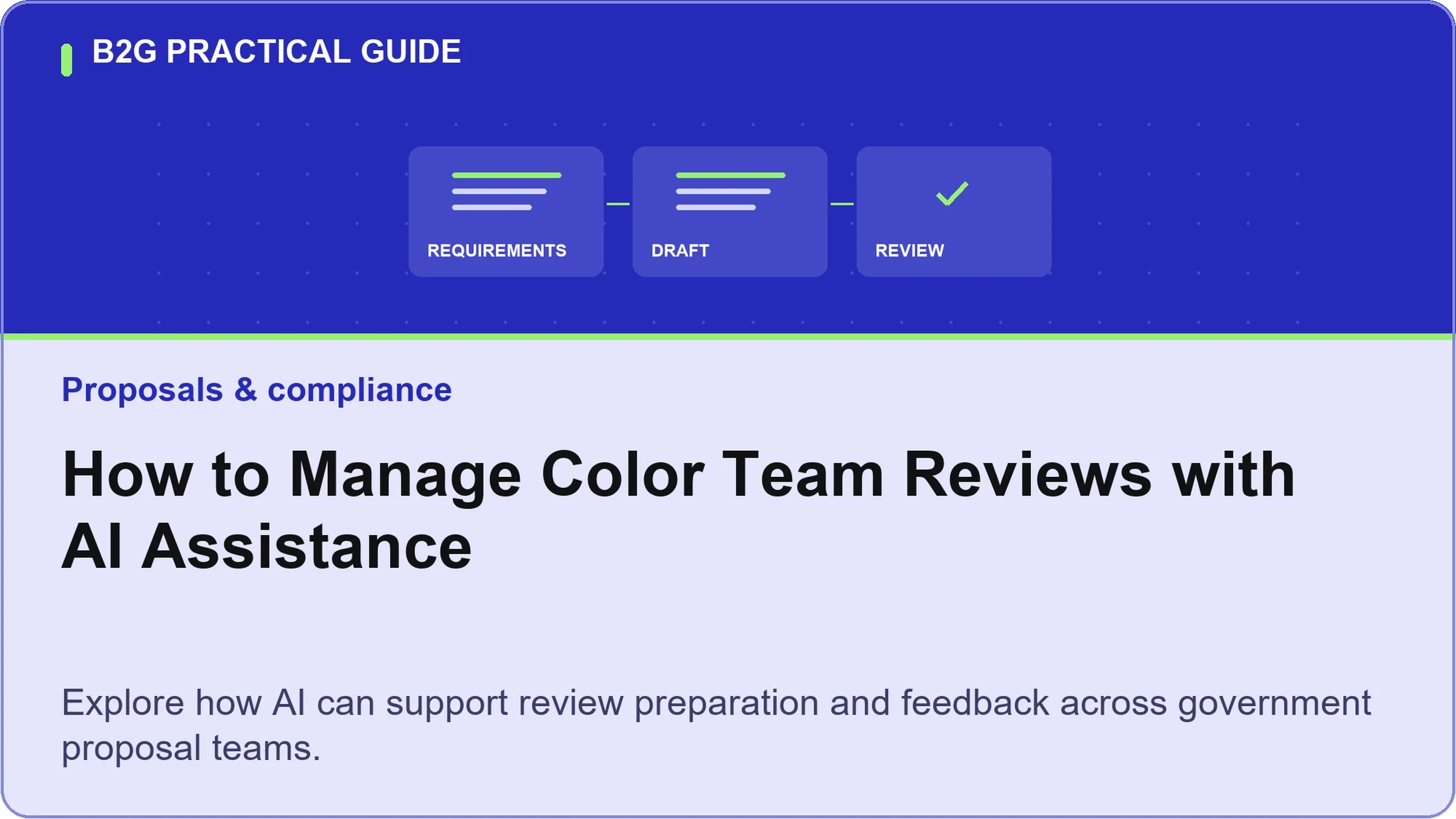
How to Manage Color Team Reviews with AI Assistance
A color-team review is a structured quality gate on a government proposal, run at set milestones. Each color checks a different question, from early-draft review to final compliance sign-off. AI assistance speeds the mechanical parts of each stage, including compliance mapping, gap surfacing, scoring support, and action tracking. This playbook walks through running color team reviews on government proposals with AI as an augmentation layer, not a replacement for reviewers.
The steps below follow a single proposal from readiness through final compliance. Civio's color-team agent runs as the worked example threaded through each stage.
Key Takeaways
Color-team reviews gate a proposal at four milestones: Pink, Red, Gold, and Blue.
AI assistance handles the mechanical layer so reviewers spend time on judgment, not on hunting for gaps.
Pre-color readiness checks catch compliance holes before reviewers ever open the draft.
A shared action tracker turns review comments into owned, dated tasks that don't get lost.
In one Civio engagement, this approach contributed to a 22% lift in Gold-team scores.
Key Terms
Color Team Review
A color-team review is a milestone-based quality gate on a proposal draft. Each color signals a stage of maturity and a distinct reviewer question.
Pink Team
The Pink team reviews an early draft or storyboard for structure, win themes, and compliance coverage. It's the first formal look at how the proposal is taking shape.
Red Team
The Red team scores a near-final draft the way a government evaluator would. Reviewers act as an independent panel judging the proposal against the evaluation criteria.
Gold Team
The Gold team is the executive review and sign-off before final production. Leadership confirms the strategy, risk posture, and pricing are sound.
Blue Team
The Blue team runs the final compliance and production check just before submission. It confirms every requirement is met and the package is ready to send.
Section L vs Section M
Section L of a federal solicitation gives instructions for preparing the proposal. Section M lists the evaluation criteria used to score it during Red and Gold reviews.
Compliance Matrix
A compliance matrix lists every solicitation requirement next to its response, owner, and status. It's the reference every color team uses to confirm coverage.
What Color-Team Reviews Are and Why They Bottleneck Proposals
Color-team reviews are structured quality gates that a proposal passes through at set milestones. Each color represents a stage of maturity and a different reviewer question. Together they catch problems early, when there's still time to fix them.
The four core reviews follow the draft as it matures. Pink team looks at the early draft, and Red team scores the near-final version. Gold team gives executive sign-off, and Blue team confirms final compliance. Some organizations add other colors, but these four carry most proposals.
Pink team reviews the storyboard or first draft. Reviewers check structure, win themes, and whether every requirement is covered. The goal is direction, not polish, since the draft is still rough.
Red team scores the near-final draft as an independent evaluator would. Reviewers read Section M, then grade the proposal against it without mercy. This is the honest dress rehearsal before submission.
Gold team is the executive review and go decision. Senior leaders confirm the bid strategy, risk posture, and pricing hold together. It's a sign-off on quality, not a rewrite session.
Blue team runs the final compliance and production check. Reviewers confirm every requirement is met, formatting is correct, and the package is submission-ready. It's the last gate before the deadline.
These reviews bottleneck proposals because prep and cleanup swallow the calendar. Reviewers spend hours confirming a draft is complete before they can judge whether it's good. Comments then scatter across documents, emails, and margins, and half get lost.
Key Insight
The bottleneck usually isn't the review itself. It's the manual prep before and the untracked cleanup after that consume the schedule.
The Association of Proposal Management Professionals treats color reviews as a discipline, not a formality. Skipping them raises risk, but running them badly burns days a team rarely has. AI assistance targets the mechanical waste at each stage.
Step 1: Pre-Color Readiness (AI Compliance Check, Reviewer Prep)
Pre-color readiness means confirming a draft is review-worthy before reviewers ever open it. The single biggest waste in color reviews is people finding gaps that a checklist could have caught. Readiness prep moves that check upstream.
Start with an AI compliance check against the solicitation. The AI maps each Section L instruction and Section M criterion to a place in the draft. Any requirement with no matching content gets flagged as a gap before the review.
This turns the compliance matrix into a live readiness dashboard. Every row shows covered, thin, or missing status. Reviewers walk in knowing the draft is complete enough to judge on merit.
Reviewer prep is the second half of readiness. Each reviewer needs the solicitation, the evaluation criteria, and a clear scoring worksheet. Sending those a few days early lets reviewers arrive ready to grade, not orient.
Pro Tip
Set a readiness threshold before any review: no draft enters Pink or Red with unresolved mandatory-requirement gaps. Hold the gate, and reviews get shorter.
In our work, this readiness step is where AI earns its place fastest. Surfacing gaps before the review saves reviewers from doing detective work in the meeting. The human reviewers then spend their hours on strategy and scoring.
Step 2: Pink Team With AI Assist
The Pink team review checks an early draft for structure, win themes, and compliance coverage. It's the first formal look, so the aim is direction, not polish. AI assist speeds the mechanical checks so reviewers focus on strategy.
Before the Pink review, AI runs a coverage pass on the draft. It confirms each required section exists and maps content to the compliance matrix. Missing or misplaced sections get flagged for the reviewers up front.
AI also surfaces where win themes are stated versus merely implied. It highlights sections that assert a benefit without evidence behind it. Reviewers then judge whether the themes are persuasive, which is human work.
During the review, reviewers concentrate on the questions AI can't answer. Do the win themes match the customer's hot buttons? Is the structure easy for an evaluator to follow? Does the story hang together across sections?
Example
On one Pink review, the AI flagged that three requirements had no drafted response yet. Reviewers skipped the hunt and spent the hour sharpening two weak win themes instead.
The output of a Pink team review is a clear list of direction changes. AI captures each comment as a tracked action with an owner. That handoff keeps early feedback from evaporating before the Red team draft.
Step 3: Red Team With AI Scoring
The Red team review scores a near-final draft the way a government evaluator would. Reviewers act as an independent panel grading against Section M. AI scoring gives that panel a faster, more consistent starting point.
Before the review, AI pre-maps the draft to each Section M criterion. It links every criterion to the passages that address it. Reviewers open a scoring worksheet already populated with evidence, not a blank page.
AI also flags weak spots that evaluators punish. Unsupported claims, vague benefits, and thin past-performance links get surfaced. Reviewers still decide the score, but they start from a map of the risks.
The AI scoring is a draft, not a verdict. It suggests a preliminary rating per criterion with the evidence behind it. Human reviewers confirm, adjust, or override each score using their judgment.
Key Data Point
Government evaluators score on Section M, not on effort. A Red team that mirrors that scoring rubric predicts the real evaluation far better than a general read-through.
This division of labor keeps the Red team honest and fast. The mechanical mapping is done, so reviewers debate substance. In our work, populated scoring worksheets cut the time reviewers spend orienting to a long draft.
Step 4: Gold Team Workshop and Tracker
The Gold team review is the executive sign-off before final production. Senior leaders confirm the strategy, risk posture, and pricing are sound. It's a go decision on quality, not a rewrite.
Run Gold team as a workshop, not a silent read. Leadership needs a tight briefing on the bid strategy and the open risks. AI prepares that briefing from the Red team results and the tracked actions.
The AI assembles a Gold team packet from prior stages. It summarizes Red team scores, unresolved comments, and the current compliance status. Executives arrive with the full picture instead of reconstructing it live.
The action tracker is the spine of the Gold team stage. Every decision becomes an owned, dated task in one shared list. Nothing that leadership flags leaves the room without an owner.
Pro Tip
Close the Gold team by reading the tracker aloud. Confirm each action has an owner and a due date before anyone leaves the workshop.
A live tracker also prevents the classic Gold team failure. Executive comments get captured, assigned, and checked off, not lost in meeting notes. That discipline is where clean drafts and higher scores come from.
Step 5: Blue / Final Compliance
The Blue team review is the final compliance and production check before submission. Reviewers confirm every requirement is met and the package is ready to send. It's the last gate, so it has to be exhaustive.
AI runs a final compliance sweep against the full solicitation. It re-checks each Section L instruction and Section M criterion against the final draft. Any requirement still marked thin or missing gets escalated immediately.
The Blue team also verifies production details the compliance matrix doesn't cover. Page limits, font rules, file formats, and required forms all get confirmed. AI checks the mechanical rules while humans confirm judgment calls.
Every Gold team action should show as closed before Blue signs off. The tracker gives a clean audit view of what changed and who confirmed it. Open items block submission until they're resolved.
Key Insight
Blue team is a verification gate, not a place for new content. If new writing shows up here, the earlier reviews didn't do their job.
When Blue team passes, the proposal is submission-ready with a documented compliance trail. That trail matters if a debrief or protest questions the response. A clean audit path is a quiet advantage.
Civio's Color-Team Agent (Worked Example)
Civio threads AI assistance through the full color-team process as an augmentation layer. Its Proposal Teammate handles the mechanical work at each gate, while human reviewers keep every judgment call. The agent prepares, maps, and tracks, but it doesn't decide who wins.
At readiness, the agent runs the compliance check that opens Step 1. It parses the solicitation, builds the compliance matrix, and flags gaps before Pink team. Reviewers start from a draft that's already been screened for holes.
Through Pink and Red, the agent supplies coverage checks and populated scoring worksheets. It maps the draft to Section M and surfaces unsupported claims. The human panel scores; the agent removes the busywork around scoring.
At Gold team, the agent builds the executive packet and runs the shared action tracker. Every decision becomes an owned, dated task in one place. At Blue team, it runs the final compliance sweep against the full solicitation.
Key Data Point
In one Civio engagement, threading this AI assistance through the color-team process contributed to a 22% lift in Gold-team scores.
That lift came from cleaner drafts reaching each review, not from AI grading the proposal. Compliance and evidence gaps closed earlier, so reviewers spent their time on strategy. Civio was incubated by AI Fund, the venture studio led by Dr. Andrew Ng.
Civio's positioning here is deliberate: augmentation, not replacement. The agent does the compliance mapping, gap surfacing, scoring support, and action tracking. The human color teams still own win themes, risk, pricing, and the go decision.
Frequently Asked Questions
What is a color team review in government proposals?
A color team review is a structured, milestone-based quality gate on a government proposal. Each color marks a stage of maturity, from early draft to executive sign-off to final compliance. The colors create predictable checkpoints so problems surface early rather than at the deadline.
What do Pink, Red, Gold, and Blue teams each review?
Pink team reviews the storyboard or first draft for structure, win themes, and compliance coverage. Red team scores the near-final draft against Section M as an independent evaluator would. Gold team is the executive review that confirms strategy, risk, and pricing before sign-off. Blue team runs the final compliance and production check right before submission.
Can AI replace human color team reviewers?
No. AI assistance handles the mechanical layer of a review, such as compliance mapping, gap surfacing, readability checks, and action tracking. Human reviewers still judge strategy, win themes, competitive positioning, and evaluator psychology. In our work, AI shortens prep and cleanup so reviewers spend their time on judgment.
How does AI speed up a Red team review?
AI speeds a Red team review by pre-mapping the draft to Section M criteria. It flags thin claims before reviewers open the document. Reviewers arrive with a scoring worksheet already populated with evidence links. That lets each reviewer focus on judgment and scoring rationale rather than on finding where a criterion is addressed.
What is a Gold team review and who attends?
A Gold team review is the executive sign-off before a proposal moves to final production. Attendees usually include senior leadership, the capture lead, the proposal manager, and pricing. They confirm the bid strategy, risk posture, and pricing are sound. Gold team is a go decision on quality, not a place to rewrite the whole proposal.
How much can AI assistance improve color team review outcomes?
Results vary by team and solicitation. In one Civio engagement, threading AI assistance through the color-team process contributed to a 22% lift in Gold-team scores. The gain came from cleaner drafts reaching each review, since compliance and evidence gaps were closed earlier.
Do small proposal teams need all four color reviews?
Not always. Small teams often combine Pink and Red into a single review, or fold Blue into a final production checklist. The principle matters more than the color count: the draft should face structure, scoring, and compliance checks before submission. AI assistance helps lean teams run fewer, tighter reviews without losing rigor.
Key Takeaways
Key Takeaways
Color-team reviews gate a proposal at four milestones: Pink for structure, Red for scoring, Gold for sign-off, Blue for compliance.
The bottleneck is prep and cleanup, so AI's biggest win is readiness checks and action tracking.
AI pre-maps drafts to Section M so Red teams score from evidence, not a blank page.
A shared, dated action tracker keeps Gold team decisions from getting lost before submission.
In one Civio engagement, threading AI through the process contributed to a 22% lift in Gold-team scores.