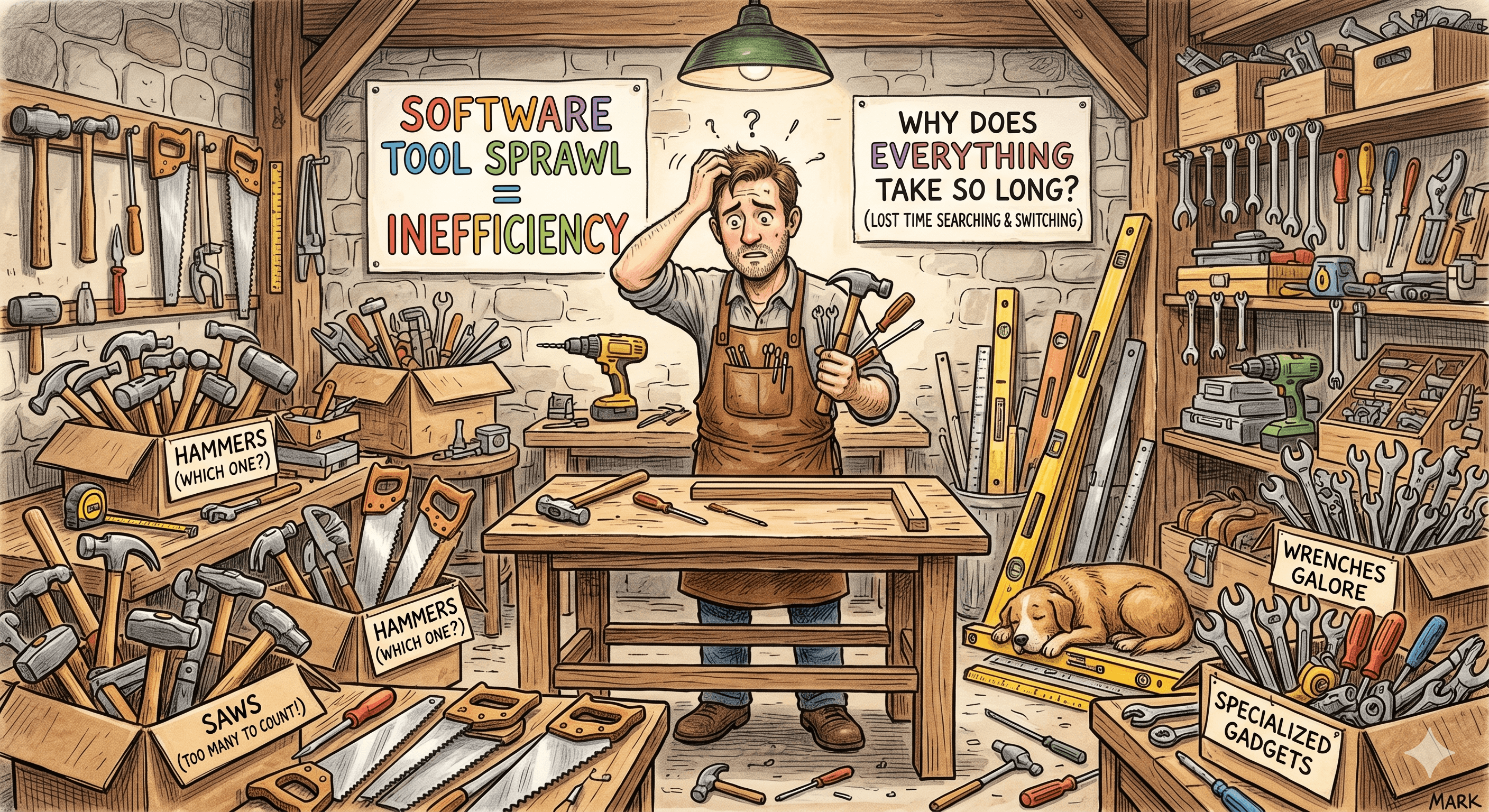
Tool Bloat Is Killing Productivity
How did we end up with more tools than ever and less time to do the work that actually matters? It's a question worth sitting with, because the answer explains a lot about where this market is headed and what it's going to take to win in it.
How We Got Here
After COVID, businesses and government agencies bought a point solution for everything: collaboration tools, project management platforms, data providers, procurement software. Work went remote overnight and every team needed something to keep moving. It made sense at the time.
The result was a rapid expansion of technology stacks that kept organizations running when nothing else could. But it came at a cost most organizations are still paying. The average GovTech or GovCon team now juggles a dozen or more disconnected systems, each with its own login, its own data, and its own version of the truth. The tools were supposed to make work easier. For many teams, they made it heavier.
AI Is Exposing the Real Problem
Every company that tries to layer AI onto a disconnected stack quickly discovers the same thing: the AI is only as good as the infrastructure underneath it. If your data lives in ten places, your processes aren't connected, and the knowledge that matters most lives in people's heads, no copilot or chatbot is going to transform how your business operates. It will produce impressive demos and modest results.
From conversations with CEOs, revenue leaders, and investors across GovTech and GovCon, the market is splitting into two camps. Both are struggling with the same fundamental problem.
The first camp is all in. They're using Claude, OpenAI, Copilot, and a growing list of AI-powered tools. These tools are impressive for one or two tasks: summarize a document, draft an email, answer a question from a dataset. But getting AI to streamline an entire lifecycle from signal to close is a completely different challenge. The gap between 'AI can help with a task' and 'AI can run a workflow' is enormous, and it's where most organizations stall.
The second camp hasn't jumped in at all. They know AI matters. They see the board asking about it and watch competitors make announcements. But they're stuck on where to invest and how to make it work without ripping everything apart.
Both are valid positions. And both lead to the same conclusion.
What Transforms the Business
Adding a chatbot or copilot to your existing stack isn't what transforms the business. What transforms it is building the infrastructure that lets AI agents operate across your data, your systems, and your processes without waiting on a person to push each step forward.
There's a critical distinction that gets lost in the AI market noise. Generative AI responds to prompts and produces content. Agentic AI operates across systems, orchestrates multi-step processes, and executes work end to end. Most companies have invested in the former and are waiting for the results that only the latter can deliver.
What Forward Deployed Actually Looks Like
Think about what changes when you strip out the admin work: the constant checking, the formatting, the copying from one system to another. Finance spends less time reconciling and more time advising. Operations spends less time reporting and more time optimizing. Business development spends less time searching and more time building relationships.
Every team becomes customer-facing. A BD rep in a GovTech company, freed from manual qualification and RFP triage, has hours back each week that currently go into process. Those hours are what relationship-building in government sales actually requires. They're what deal shaping before the RFP drops requires. The capacity already exists inside most teams. The infrastructure is what's missing.
Before evaluating your next AI investment, ask one question: does it add another tool to manage, or does it remove the need to manage tools at all? The answer tells you whether you're investing in the last era or the next one.
About the Author
James Ha is the CEO and Co-Founder of Civio, a B2G AI infrastructure and revenue orchestration platform for technology vendors and consulting firms selling into U.S. government markets. He brings more than 20 years in GovTech, experience working with over 5,000 government agencies, and deep expertise managing and scaling teams across the full customer lifecycle, including planning, procurement, contracting, and writing more than 300 RFPs for complex enterprise systems.