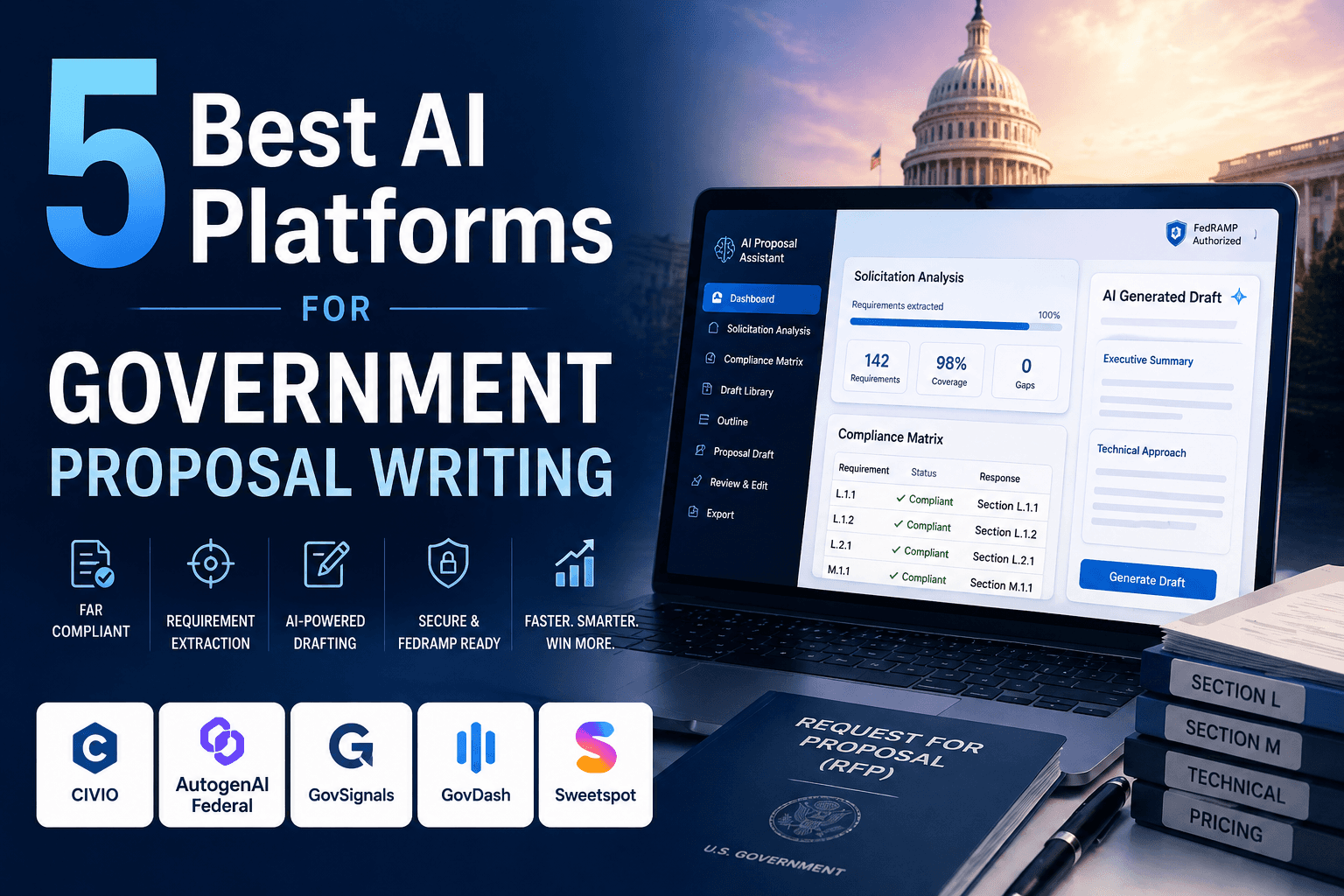
5 Best AI Platforms for Government Proposal Writing
AI proposal writing for government contracts uses artificial intelligence to draft, structure, and refine proposal responses to government solicitations. Government-specific platforms go beyond generic text generation by understanding FAR requirements, parsing evaluation criteria, generating compliance matrices, and producing content structured to score well under government evaluation frameworks.
The need for AI in government proposal writing is well documented. The 2025 Deltek Clarity GovCon Study found that government contractors spend over seven hours developing the first draft of a single proposal. That number doesn't include requirement extraction, compliance review, or formatting. With teams handling multiple concurrent pursuits, the time investment becomes the primary constraint on bid volume and quality.
The performance gap between AI adopters and non-adopters is widening. AutogenAI reports that its federal customers reduced first-draft timelines from 25+ hours to under 5 minutes for requirement extraction, structuring, and initial drafting. Sweetspot reports teams are leaving legacy tools behind because its shred-and-draft process generates pink team drafts in minutes.
This guide ranks the five best AI platforms for government proposal writing in 2026. The evaluation considers writing quality, FAR compliance, requirement extraction accuracy, content approach, security posture, and lifecycle integration.
Key Terms
AI Proposal Writing: Using artificial intelligence to generate proposal narrative from solicitation requirements, approved content libraries, and company data. Government-specific AI produces FAR-compliant content; generic AI does not.
Compliance Matrix: A structured document mapping each solicitation requirement to the corresponding proposal section. AI-generated compliance matrices ensure complete requirement coverage and prevent disqualification from missed items.
Section L and M: Federal solicitation sections defining proposal instructions (L) and evaluation criteria (M). AI platforms that parse beyond L and M into Statements of Work and attachments capture requirements other tools miss.
Shredding: The process of extracting and categorizing individual requirements from a solicitation document. AI shredding produces a structured list of requirements that drives the proposal outline and compliance matrix.
Content Library: A centralized repository of approved responses, past performance narratives, resumes, and boilerplate. AI writing platforms draw from these libraries to generate tailored content grounded in verified company data.
Pink Team Draft: An early-stage proposal draft reviewed for structure, responsiveness, and compliance coverage before detailed writing begins. AI can generate pink team drafts in minutes rather than the days or weeks required manually.
FAR (Federal Acquisition Regulation): The primary rules governing U.S. federal procurement. FAR-trained AI produces compliant content; generic AI produces text that may violate regulatory requirements without the writer knowing.
Key Insight
The critical distinction in AI proposal writing for government isn't speed. It's compliance awareness. Generic AI tools like ChatGPT can produce fluent text quickly, but that text doesn't understand FAR, CPARS, evaluation criteria, or Section L/M structures. Government-specific AI is trained on federal procurement data and produces content structured to score well under government evaluation frameworks. The speed advantage only matters when the output is compliant enough to submit.
1. Civio
Quick Summary
Civio writes government proposals as one function within a fully automated B2G revenue workflow. Its RFP Proposal Teammate reads solicitations, pulls from approved content, fills government forms, and delivers compliant first drafts, while upstream AI teammates ensure proposals are only written for opportunities that have already been qualified and scored.
Civio approaches AI proposal writing differently from standalone writing tools. The platform treats proposal writing as one step in an orchestrated revenue cycle, not an isolated document production task. Before a word is drafted, Civio's AI teammates have scored the opportunity on fit, intent, and access, qualified the deal, and routed it to the right team with context attached.
Incubated by AI Fund, the venture studio led by Dr. Andrew Ng, Civio deploys specialized AI teammates for each function. The RFP Proposal Teammate reads solicitation files, pulls from the team's approved content library, and delivers compliant first drafts. A Sales Engineer Teammate fills requirement matrices cell by cell with verified, source-linked answers.
This upstream-downstream connection is what separates Civio from writing-only tools. The most expensive proposal writing failure isn't slow drafting. It's writing proposals for the wrong opportunities or writing without the capture context that makes proposals competitive. Civio ensures every AI-written proposal starts with qualified deal intelligence, not a blank page.
Civio also recommends teaming partners when capability gaps appear during proposal development, solving a problem that standalone writing tools ignore. The 30-day proof-of-value sprint lets teams evaluate AI writing quality on real solicitations before committing.
Key Features
AI-generated proposal drafts from approved content libraries with built-in compliance tracking
Requirement matrix completion with verified, source-linked answers filled cell by cell
Upstream AI qualification ensuring proposals are only written for scored, qualified deals
Teaming partner recommendations when capability gaps appear during writing
AI teammates spanning RevOps, BDR/SDR, proposal, sales engineering, and customer success
Unified CRM and data source integration for context-rich proposal content
30-day proof-of-value sprint for evaluation
Who Should Choose Civio
B2G revenue teams where proposal writing must be connected to upstream qualification and downstream execution, not just the drafting stage
Companies selling SaaS, cloud, or IT services to government that need AI writing embedded in the full deal lifecycle
Revenue leaders who want AI that writes proposals from qualified deal context, not from a blank page
2. GovDash
Quick Summary
GovDash writes government proposals using FAR-trained AI that parses complete solicitation packages, generates compliance matrices, and drafts technical narratives 50 to 60% faster than manual methods. Its Word Assistant embeds AI drafting directly into Microsoft Word.
GovDash's proposal writing engine is built specifically for government contracting workflows. The AI parses full solicitation packages beyond Sections L and M to capture requirements hidden in Statements of Work, amendments, and attachments. The company raised a $30M Series B in January 2026. Customers won more than $5 billion in government contracts in 2025.
The Word Assistant is a key differentiator: proposal writers draft directly within Microsoft Word with AI generating compliant content in real time. Templates, cover pages, and stylistic preferences carry through every draft. SPATHE Systems reported cutting draft turnaround by 90% and scaling IDIQ responses from two to eight per month without adding staff.
Key Features
FAR-trained AI parsing full solicitation packages beyond Sections L and M
Word Assistant embedding AI proposal drafting directly into Microsoft Word
Automated compliance matrix generation with requirement extraction
Proposal writing reducing cycle times by 50 to 60%
Stylistic templates, cover pages, and formatting carried through every draft
FedRAMP-compliant infrastructure on Azure GovCloud
Who Should Choose GovDash
Federal contractors that need AI writing trained specifically on FAR and government procurement data
Proposal teams working primarily in Microsoft Word that want AI embedded in their existing writing environment
Mid-market firms scaling proposal output without adding writing headcount
GovDash vs. Civio
GovDash writes government proposals with FAR-trained AI embedded directly in Microsoft Word. Civio writes proposals within a full revenue workflow where upstream AI qualification ensures every draft starts with deal context. GovDash is the stronger choice for dedicated proposal teams that need the best in-Word writing experience. Civio is the stronger choice for revenue teams that need AI writing connected to qualification, engineering, and post-sale execution.
Comparison Point | Civio | GovDash |
|---|---|---|
Writing Environment | AI-generated drafts from content libraries | Word Assistant embedded in Microsoft Word |
AI Training | B2G content and solicitation data | FAR-specific federal procurement data |
Pre-Writing | AI qualification, scoring, routing | Capture management, Bid Match |
Compliance Matrix | Integrated into proposal workflow | Full solicitation parsing beyond L/M |
Post-Writing | Sales engineering, customer success | Contract Cloud administration |
Best For | Full-funnel B2G revenue teams | Proposal-centered writing teams |
Pro Tip
When testing AI proposal writing platforms, measure "usable draft rate," the percentage of AI-generated content that survives into the final submission without rewriting. A tool producing a draft in 5 minutes that requires 8 hours of rework isn't faster than one taking 30 minutes with light editing needed. In our testing, the gap between platforms on this metric is larger than the gap on raw generation speed. Ask vendors for their customers' usable draft rate and request references who can confirm it.
3. AutogenAI Federal
Quick Summary
AutogenAI Federal writes government proposals at the highest AI quality level in the market, building a custom language engine for each customer. FedRAMP High authorized with CMMC 2.0 and DoD IL5 compliance. Independent MH&A research found users grew revenue 12.4% year-on-year.
AutogenAI Federal's core differentiator is writing quality. The platform builds a dedicated AI engine trained exclusively on each organization's documents, past proposals, and win themes. Three engines power the output: Creative AI generates original persuasive narrative, Library AI draws from past proposals and approved content, and Internet AI pulls real-time cited data from external sources.
AutogenAI reports reducing time from over 25 hours for requirement extraction and first-draft development to under 5 minutes. The platform covers the full proposal lifecycle from capture planning through compliance review and submission. AI-powered color review scoring evaluates automated drafts against RFP requirements before human reviewers begin their work.
Key Features
Custom AI language engine trained on each customer's documents and writing voice
FedRAMP High authorized with CMMC 2.0 and DoD IL5 compliance
Three AI engines: Creative AI, Library AI, and Internet AI with real-time citations
Requirement extraction and first-draft generation in under 5 minutes
AI-powered color review scoring drafts against RFP requirements
Multi-document shredding and automated compliance matrix generation
Who Should Choose AutogenAI Federal
Proposal teams where AI writing quality is the primary competitive differentiator, not just speed
Defense and intelligence contractors requiring FedRAMP High and IL5 environments for proposal data
Organizations that need persuasive, differentiated narrative, not just compliant boilerplate text
AutogenAI Federal vs. Civio
AutogenAI Federal writes government proposals at the highest quality level within FedRAMP High security. Civio writes proposals within a full-funnel revenue workflow where AI teammates handle qualification through close. AutogenAI is the best choice for teams with strong pipeline management that need a world-class writing partner. Civio is the best choice when the writing problem is inseparable from the qualification, routing, and execution problems.
Comparison Point | Civio | AutogenAI Federal |
|---|---|---|
Writing Quality | Compliant, context-rich from deal data | Best-in-class persuasive narrative |
AI Model | Approved content library + AI drafting | Custom language engine per customer |
Security | Enterprise-grade | FedRAMP High, CMMC 2.0, DoD IL5 |
Pre-Writing | AI qualification, scoring, routing | Capture planning, bid/no-bid |
Review Automation | Integrated quality checks | AI color review scoring vs. requirements |
Best For | Full-funnel B2G revenue writing | Writing-quality-focused proposal teams |
4. Procurement Sciences (Awarded AI)
Quick Summary
Procurement Sciences writes government proposals through Awarded AI with compliance-first drafting, structured color review automation, and win strategy generation. FedRAMP Moderate authorized, serving 300+ organizations with on-premises deployment for CUI and ITAR data.
Procurement Sciences approaches AI proposal writing through compliance discipline. The company closed a $30M Series B in November 2025. One Top 100 GovCon customer reported that every bid using the AI has won. The platform automates drafting with built-in cross-checking against RFP requirements, generates win strategies, and automates the color review process.
Deployment flexibility is a key differentiator for teams handling sensitive proposal data. The platform runs on Azure Commercial, GovCloud (GCC High), and on-premises for organizations that can't send CUI or ITAR data to any cloud. Teams report 90%+ efficiency gains and up to 10x proposal output, with some teams increasing response capacity by 150% using the same headcount.
Key Features
FedRAMP Moderate with CMMC and NIST 800-171 alignment
Compliance-first AI drafting with automated cross-checking against requirements
Win strategy generation informing proposal positioning and differentiation
Color review automation with structured gate reviews and validation
Flexible deployment: commercial cloud, GovCloud, or on-premises
Competitive intelligence feeding proposal win themes
Who Should Choose Procurement Sciences
Defense and intelligence contractors requiring FedRAMP authorization and CUI-grade environments for proposal work
Large GovCon firms needing structured, auditable AI writing processes with formal review gates
Organizations where compliance verification is as critical as writing speed in the proposal workflow
Procurement Sciences vs. Civio
Procurement Sciences writes proposals with compliance-first AI in auditable, structured workflows. Civio writes proposals within autonomous AI workflows that handle the full revenue cycle. Procurement Sciences is the stronger choice for regulated environments requiring formal documentation at every writing stage. Civio is the stronger choice for teams that need writing speed and full-funnel connection from qualification through execution.
Comparison Point | Civio | Procurement Sciences |
|---|---|---|
Writing Approach | AI teammates draft from content libraries | Compliance-first AI with cross-checking |
Security | Enterprise-grade | FedRAMP Moderate, CMMC, NIST 800-171 |
Deployment | Cloud-based | Commercial, GovCloud, on-premises |
Review Automation | Integrated quality checks | Full color review automation with gates |
Lifecycle Scope | Signal through post-sale | Discovery through delivery |
Best For | Speed-focused B2G revenue teams | Compliance-focused defense contractors |
Key Data Point
The 2025 Deltek Clarity GovCon Study found that government contractors spend over seven hours developing the first draft of a single proposal. AutogenAI reports reducing extraction and drafting from 25+ hours to under 5 minutes. GovDash reports 50 to 60% faster proposal cycles. The data consistently shows that AI proposal writing isn't a marginal efficiency gain. It's a structural transformation in how proposals are produced.
5. GovSignals
Quick Summary
GovSignals writes government proposals within a FedRAMP High authorized environment, combining AI drafting with insider-sourced intelligence and automated compliance checking. Over 400 organizations use the platform for federal, SLED, and international proposal work.
GovSignals brings two unique capabilities to AI proposal writing: FedRAMP High security and proprietary intelligence sources. The platform generates auto go/no-go assessments, compliance checks, proposal outlines, and full draft proposals from uploaded solicitations. Its insider-sourced leads surface opportunities before SAM.gov, giving writing teams more preparation time.
The platform creates, edits, and exports proposals in Word, Excel, PowerPoint, and PDF formats, mapping directly to how proposal teams already work. An internal knowledge AI analyzes company files, reads policies, and preps teams for capture meetings, ensuring proposal writers have complete context before drafting begins. Most clients report results within two weeks of white-glove onboarding.
Key Features
FedRAMP High authorization for the most sensitive proposal data
Auto go/no-go, compliance checks, outlines, and full draft generation
Insider-sourced intelligence feeding proposal positioning and win themes
Full document creation in Word, Excel, PowerPoint, and PDF formats
Internal knowledge AI analyzing company files and policies for writing context
White-glove onboarding with results in approximately two weeks
Who Should Choose GovSignals
Contractors handling classified or sensitive data requiring FedRAMP High for all proposal writing activity
Teams that want insider-sourced intelligence directly informing proposal win themes and positioning
Defense primes needing secure, end-to-end proposal writing from capture through submission
GovSignals vs. Civio
GovSignals writes proposals within FedRAMP High security with analyst-sourced intelligence informing every draft. Civio writes proposals within a full-funnel revenue workflow with AI teammates across every stage. GovSignals is the strongest choice for high-security environments where intelligence quality drives proposal content. Civio is the strongest choice for teams that need AI writing connected to qualification, routing, and post-sale execution.
Comparison Point | Civio | GovSignals |
|---|---|---|
Security | Enterprise-grade | FedRAMP High |
Intelligence | AI-scored unified signals | Insider-sourced + public feeds |
Writing Scope | Full proposals + requirement matrices | Outlines, compliance, and full drafts |
Document Formats | Proposals and matrices | Word, Excel, PowerPoint, PDF |
Lifecycle | Signal through post-sale | Capture through contract execution |
Best For | Full-funnel B2G revenue writing | High-security intelligence-driven writing |
Before and After: AI Proposal Writing for Government
Before AI writing: A proposal writer spends 7+ hours on a first draft for a single section. The team extracts requirements manually from a 120-page solicitation over 3 days. Compliance review takes a week because the matrix was built by hand. Total: 100+ hours per proposal, 3 submissions per quarter.
After AI writing: AI extracts requirements in minutes and generates a structured, compliant first draft in under an hour. The compliance matrix is auto-generated. Writers focus on strategy, differentiation, and refinement. Total: 30 to 40 hours per proposal, 8 to 10 submissions per quarter with higher compliance rates.
Full Comparison: All 5 AI Platforms for Government Proposal Writing
Capability | Civio | GovDash | AutogenAI Federal | Procurement Sci. | GovSignals |
|---|---|---|---|---|---|
Writing Approach | Content library + AI | FAR-trained Word AI | Custom engine/customer | Compliance-first AI | Intel-informed AI |
Gov-Specific Training | B2G content + solicitations | FAR procurement data | Custom per customer | FAR + compliance | Federal procurement |
Compliance Matrix | Yes | Yes (beyond L/M) | Yes | Yes | Yes |
Writing Quality | Compliant + contextual | FAR-compliant | Best-in-class | Compliance-first | Compliance-focused |
Security | Enterprise | FedRAMP-equivalent | FedRAMP High | FedRAMP Moderate | FedRAMP High |
Pre-Writing | Full pipeline + qualification | Capture management | Capture + bid/no-bid | Capture management | Capture + intel |
Review Automation | Quality checks | Compliance checks | AI color review | Color review gates | Compliance checks |
Lifecycle Scope | Signal to post-sale | Discovery to contract | Capture to submission | Discovery to delivery | Capture to contract |
Best For | Full-funnel B2G | Proposal teams | Writing quality | Defense/intel | High-security |
Start Here: Action Checklist
Measure current writing time. Track hours per proposal from requirement extraction through pink team draft. If first-draft development takes 7+ hours per section (the Deltek Clarity benchmark), AI writing will deliver immediate ROI.
Classify the writing challenge. If the bottleneck is writing speed, prioritize tools with the fastest generation (AutogenAI, GovDash). If it's compliance coverage, prioritize compliance-first tools (Procurement Sciences). If the bottleneck spans qualification through submission, prioritize full-lifecycle platforms (Civio).
Define the security floor. Proposals involving CUI, ITAR, or classified data require FedRAMP-authorized platforms: AutogenAI Federal and GovSignals (High), or Procurement Sciences (Moderate). CMMC 2.0 enforcement makes this non-optional for defense work.
Test with a real solicitation. Upload a recently completed RFP into 2 to 3 finalists. Have the AI write against it. Compare the AI draft against the team's submitted version for compliance coverage, structure quality, and usable content percentage.
Calculate full cost of ownership. Include seat pricing, onboarding, content library migration, and remaining manual writing effort. Tools with low sticker prices but high manual rework costs often exceed the total cost of premium platforms.
Frequently Asked Questions
What is AI proposal writing for government contracts?
AI proposal writing uses artificial intelligence to draft, structure, and refine proposal responses to government solicitations. Government-specific platforms understand FAR, parse evaluation criteria, generate compliance matrices, and produce content structured for government scoring frameworks. This goes beyond generic text generation.
Can AI write a winning government proposal?
AI produces compliant first drafts that significantly reduce writing time and improve compliance. Teams report 50 to 70% faster drafting and 2 to 3x higher bid volume. Human review remains essential for strategy, differentiation, and accuracy. AI handles the heavy lifting; experts ensure the proposal wins.
How is government AI writing different from ChatGPT?
Generic AI doesn't understand FAR requirements, evaluation criteria, CPARS formatting, or solicitation structures. Government-specific AI is trained on federal procurement data, parses Section L/M, generates compliance matrices, and produces evaluator-ready content. The difference directly impacts compliance accuracy and win rates.
What security standards are needed?
For proposals with CUI or ITAR data, FedRAMP is the standard. AutogenAI Federal and GovSignals hold FedRAMP High. Procurement Sciences holds Moderate. SOC 2 Type II is the minimum for less sensitive work. CMMC 2.0 enforcement makes non-authorized tools a compliance risk.
How long does implementation take?
GovDash reports week-one productive use. GovSignals delivers within two weeks. Civio offers a 30-day proof-of-value sprint. AutogenAI Federal builds a custom engine during onboarding. Timelines depend on content migration, integrations, and historical data volume.
Does AI replace human proposal writers?
No. AI handles the mechanical work: extraction, first drafts, compliance checking, and form filling. Human writers focus on strategy, differentiation, win themes, and quality. The Deltek Clarity study found writers spend 7+ hours on a single first draft. AI reduces that to minutes, freeing writers for higher-value contribution.
Pro Tip
Don't evaluate AI proposal writing platforms on speed alone. The real cost in government proposals is rework: drafts missing requirements, content that doesn't address evaluation criteria, and submissions failing compliance review. Test compliance matrix accuracy and requirement extraction coverage alongside writing speed. A fast draft missing 20% of requirements costs more than a slower draft capturing everything.