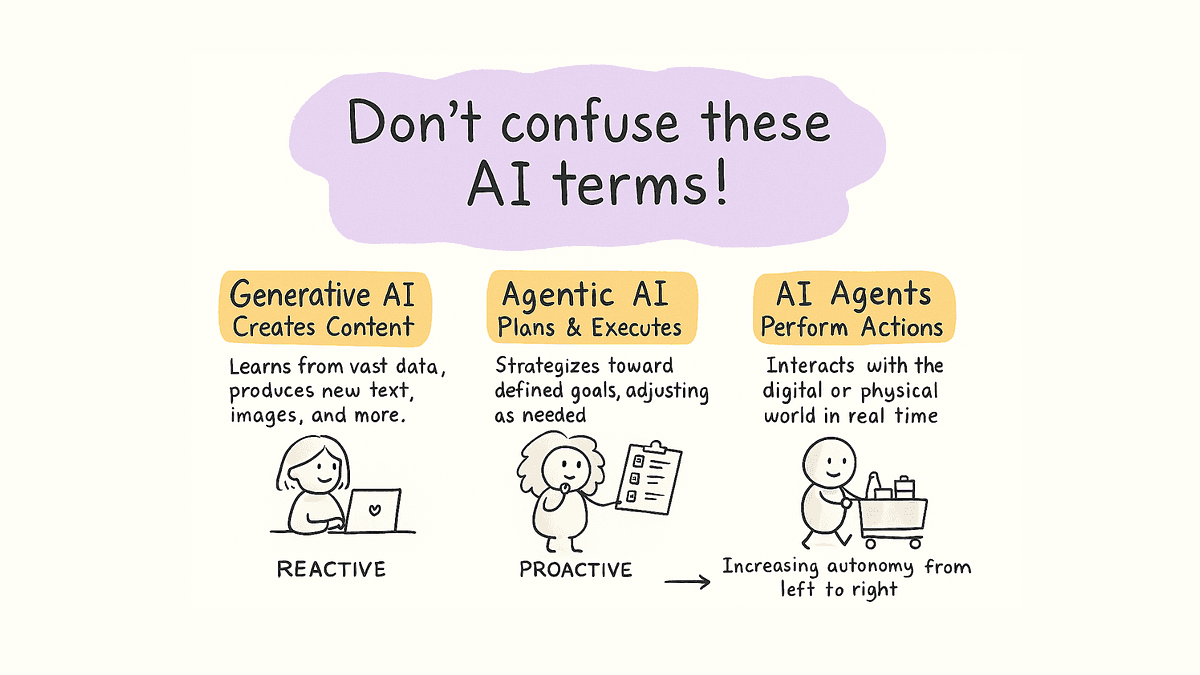
Why the GenAI vs. Agentic AI distinction will define GovTech 2.0
Every government technology vendor is now talking about AI. The language is starting to blur. Generative AI, autonomous workflows, intelligent automation, and agentic AI are presented as if they mean the same thing. They don't.
For GovTech leaders, this isn't a semantic debate. It's a strategic distinction that will shape product decisions, procurement decisions, and platform architecture over the next several years. Getting it wrong is expensive, not because you'll buy a bad product, but because you'll build your operating model around the wrong assumptions about what AI can do.
What Actually Changes Between GenAI and Agentic AI
Generative AI helps people produce and interpret information. It can summarize an RFP, draft a response, generate talking points, or answer questions in context. The human remains responsible for deciding what happens next.
Agentic AI goes further. It can carry out sequences of work across systems: reviewing a procurement document, applying qualification criteria, updating records, routing tasks, and preparing outputs for approval, without waiting on a person to initiate each step. The AI isn't just informing the workflow. It's participating in it.
A generative AI tool helps a person do the work. An agentic system participates in the work itself. The interface may look similar. The operating model is not.
The requirements are very different as a result. A generative AI tool can be useful with relatively limited system access and a straightforward review model. An agentic system requires clear permissions, reliable state management, approval checkpoints, and auditability. In government environments, where accountability and traceability are non-negotiable, those requirements are not optional add-ons.
Why This Confuses the Market
A number of products appear agentic because the interface feels fast and responsive. But in many cases, a person is still initiating each meaningful step. That doesn't make those products bad. It means they're better understood as AI-assisted software than as genuinely agentic systems.
Over time, buyers will need to get more precise about that distinction. The vendors who are honest about it now will earn more trust than those who treat every AI capability as interchangeable.
Where the Market Is Heading
Governments and the vendors serving them are moving toward more interoperable AI infrastructure. The direction is clear even if timelines vary by agency and jurisdiction: beyond standalone chat experiences and toward operational uses of AI that sit inside real workflows.
As model performance improves across the board, the operational layer becomes the competitive variable. Identity and delegation, approval logic, audit trails, interoperability, controls that match government risk tolerance: building that layer is harder than fine-tuning a model. It's also harder to replicate.
The Questions Buyers Should Be Asking
The most useful evaluation questions aren't about which model a vendor uses or how polished the demo looks.
Does the system simply assist a human, or can it take action within a workflow without being prompted for each step? If it takes action, what permissions govern that behavior? What is logged, reviewable, and reversible? Where are the human checkpoints? Can the system connect to a broader architecture, or does it operate in isolation?
Those questions separate a helpful AI feature from a system that's actually ready to operate in government workflows. Most vendors won't have clean answers to all of them. That's the point. The ones who do have built something durable.
The Practical Takeaway
GovTech is moving toward AI-enabled operating models, not just AI-enhanced interfaces. Vendors who understand the difference and build for it will be in a stronger position as government buyers get more precise about what they need. Vendors who treat every AI capability as interchangeable will still win attention in the short term. They'll have a harder time becoming durable infrastructure.
The question to ask in any vendor conversation is simple: is a human still initiating every meaningful step, or has the system earned the right to act? The answer tells you more about where a product actually is than any demo will.
About the Author
James Ha is the CEO and Co-Founder of Civio, a B2G AI infrastructure and revenue orchestration platform for technology vendors and consulting firms selling into U.S. government markets. He brings more than 20 years in GovTech, experience working with over 5,000 government agencies, and deep expertise managing and scaling teams across the full customer lifecycle, including planning, procurement, contracting, and writing more than 300 RFPs for complex enterprise systems.