How Many Enrichment Sources Does It Take to Trust Your CRM?
Most B2G sales teams score deals off one or two data sources. A contact record in the CRM, maybe a bid alert from a procurement monitoring tool, and the opportunity gets a score. The rep gets a territory. The deal rolls into the forecast. Leadership treats it like a signal of pipeline health.
In government sales, that's not real qualification. The buying process is fragmented across legislative cycles, budget authorities, procurement rules, and individual department decisions. A state agency can have a funded mandate and zero procurement activity for two years while the budget sits in committee. A municipality can issue a solicitation with a 21-day response window that your team never saw because no one was tracking the right database.
In B2G, you can have a perfect-fit account with zero pipeline value if you do not know when the money moves and who controls the decision.
Scoring fit alone is not enough. Scoring intent alone is not enough. You need both, plus a clear read on whether you actually have access to the people who matter. That's three distinct signal categories, each requiring its own verified sources. When you map them out, the data footprint required for honest qualification becomes clear, and it's more than most teams are running.
The Three Signal Categories
Civio's FIA framework, which stands for Fit, Intent, and Access, was built because BANT and MEDDIC don't translate cleanly to government sales cycles. Each signal category answers a fundamentally different question and requires different data sources.
Signal Type | What It Tells You | Sources | Key Question |
Fit | Is this account a real target? | Policy intel, legislative tracking, budget and fiscal data, contract spend analysis | Does this government have the mandate and money? |
Intent | Is this account moving toward a buy? | Procurement alerts, bid monitoring, solicitation tracking, public transcripts, CRM activity | Is there an active procurement underway? |
Access | Can you get to the right people? | Relationship mapping, stakeholder intel, conference data, CRM enrichment | Do you know the people who control the decision? |
The critical point is that none of these source categories overlap. Policy intelligence doesn't tell you whether a solicitation has been issued. Procurement alerts don't tell you whether the account has a funded mandate. Relationship mapping doesn't tell you whether the deal is in active procurement. You need all three layers to score with confidence.
Fit: Does This Account Have the Mandate and the Money?
Fit in B2G starts with two separate questions: does the government entity have a policy reason to buy what you sell, and is there money attached to that reason?
Policy intelligence tools track legislative activity at the federal, state, and local level. They surface the upstream triggers for most government technology buys. Without them, your team is reacting to solicitations already written by someone else's champion. Budget and fiscal data tells you whether an entity has appropriated funds for the category you sell into. A mandate without appropriated budget means a longer and less predictable sales cycle. Contract and spend analysis tools like USASpending or FPDS show you historical purchasing patterns. If an agency has spent consistently with a competitor for four years, that's a fit signal your rep needs to account for before the first call.
Intent: Is This Account Moving Toward a Buy Right Now?
Intent in government sales is more binary than in commercial sales. Either there's an active procurement underway or there isn't. The window to engage is often short once one opens.
Procurement alert tools monitor bid databases across federal, state, and local jurisdictions, but no single tool covers everything. Most growth-stage companies run two or three in parallel to avoid gaps. Public transcripts and meeting minutes from city councils and state legislative committees are an underused layer. When a department head requests funding for a specific technology category in a public meeting, that's an intent signal that precedes a formal solicitation by six to eighteen months.
Your own CRM data is also an intent signal, and it's the one most teams underweight. Prior relationships with the account, past proposal submissions, previous loss or win data: all of it informs where this account sits in your cycle. Intent scoring that ignores internal signals is leaving information on the table.
Access: Do You Know the People Who Control the Decision?
In government sales, access is often the deciding variable. Two vendors with identical fit scores and identical intent signals will have completely different outcomes depending on whether one has a relationship with the department head whose office championed the initiative.
Relationship mapping tools surface second and third-degree connections your team may not know exist. In a market where cold outreach to government buyers has a low hit rate, a warm introduction through a mutual contact is a meaningful advantage. Conference and event data tells you where government buyers are showing up and what they're focused on. A new CIO is one of the most reliable triggers for technology re-evaluation in government. Teams that engage early, before the new leader commits to an incumbent's renewal, win a disproportionate share of the deals they pursue.
The Two Questions Every Account Must Answer
With all three signal categories in place, the scoring model still has to produce something actionable. In practice, two questions determine whether an account deserves pipeline investment.
Has this account been funded? And do you have access to the stakeholders who control the decision?
If the answer to the first question is no, the account belongs in a nurture track tied to the legislative and budget calendar, not in active pipeline. If the answer to the second is no, the first priority is not a discovery call. It's building access. Moving an account into active pipeline before you have access to the decision-maker is one of the most common ways B2G sales cycles drag without resolution.
If you can't answer both questions with verified data, you don't have a pipeline entry. You have a lead that hasn't been qualified yet.
The Five-Plus Tool Reality
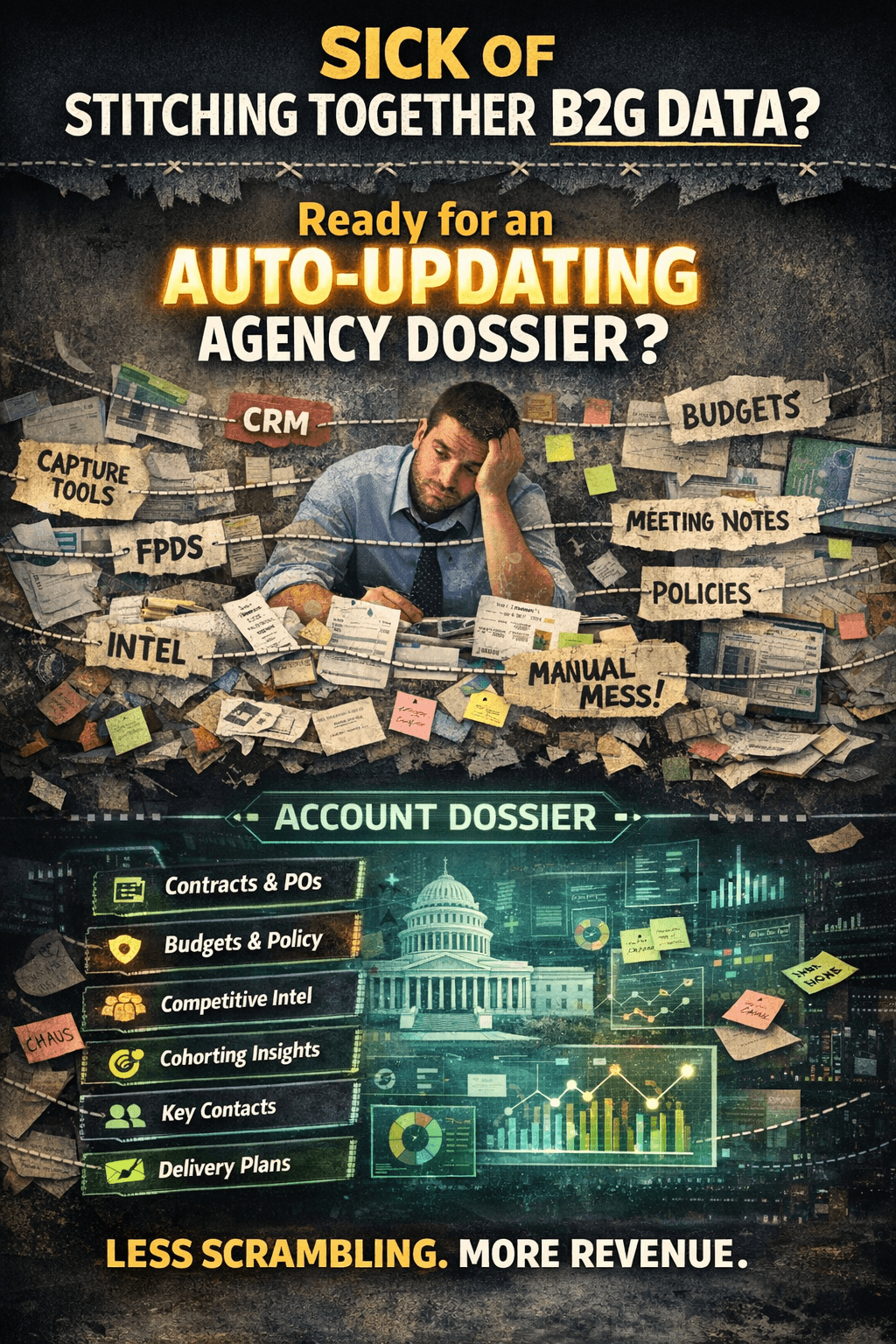
When you map out the signal categories and what each requires, the data footprint becomes clear. Growth-stage companies selling into government typically run one or two policy and legislative intelligence tools, one or two procurement monitoring platforms, a budget and fiscal data source, a contract and spending analysis tool, and a relationship and stakeholder intelligence layer. That's five or more tools before you've accounted for your CRM or marketing automation platform.
The cost adds up. But the alternative, scoring pipeline off incomplete data and running reps at accounts that can't close, costs more. Teams who get this right don't just close more deals. The pipeline gets smaller and more accurate. Forecast confidence goes up. And the conversation between sales and marketing becomes about data instead of disagreement.
The teams who trust their pipeline have earned that trust. They built the data layer underneath it.
About the Author
James Ha is the CEO and Co-Founder of Civio, a B2G AI infrastructure and revenue orchestration platform for technology vendors and consulting firms selling into U.S. government markets. He brings more than 20 years in GovTech, experience working with over 5,000 government agencies, and deep expertise managing and scaling teams across the full customer lifecycle, including planning, procurement, contracting, and writing more than 300 RFPs for complex enterprise systems.